Felt Flowers

Hello again, Reader.

Spring is creeping in everywhere, taking winter’s place and putting me in a good mood. So to join in the fun, I thought I’d share these instructions for simple, pretty felt flowers. I like this idea for a number of reasons: it’s dead easy, so it’s great to do with little helpers. The results are pretty and versatile. You can use them to dress up pretty much any surface imaginable. They’d make great additions to spring-time cardigans, festive table-runners, or even bobby-pins and hairbands for the flower child in all of us. They’d also make great bouquets and wreaths, depending on their size.

These bright little blossoms are also great because they are so easy to customise. They can be any size, shape, and colour you like. The plain version that I’ve detailed here look a bit like ranunculi or shrub roses, but depending on how you customise your blooms, they might look completely different. You can dress them up with beads and buttons. You can use pinking shears to make any kind of petal you can think of. The instructions below stick with the basics, but your flowers can look any way you choose.

The final reason I love these pretty petals is that they use up left-over felt. I always seem to have felt flotsam and jetsam floating around in my sewing cubby. Where does it come from? Why is it there? I don’t have the answers to these questions, but happily, with these flowers, it doesn’t really matter. I can use it up instead of leaving it to take up space.

So let’s get growing. Here’s what you’ll need:

  • felt 20160306_130728[1](any colour- I usually try to have two colours for petals and leaves, but that’s up
    to you)
  • scissors/shears
  • needle and cotton thread


Now that you’ve got all your equipment together, here’s how to get started:

Step 1: Using your shears, cut circles of different sizes into the felt you want to use for your petals. In my case, I’m going to save the green felt for leaves, but the red and lilac felt are for petals. If you are making felt flowers with children, you may need to help them with this step: shears are very sharp, and child-safe scissors are often not sharp enough to cut through felt (or any other fabric, for that matter).

20160306_130914[1].jpg

Step 1

Step 2: Cut each felt circle into a spiral, starting from the outside and working your way towards the centre. Once you reach the middle, cut the absolute centre out of your spiral, so that there’s a small hole in the middle. If you want textured petals, now is the time to trim one side of the felt spiral into any repeated shape you like. This side will be the top of your flower. It should look like this:

20160306_130955[1].jpg

Step 2

Step 3: Beginning from the centre of your spiral, roll up the felt strip. It should look a bit like a cinnamon roll. I found it helpful to pinch it gently between my fingers to keep it flat. Keep rolling until you’ve reached the end of your felt strip. Put your little roll of felt down flat.

20160306_131045[1]

Step 3

20160306_131145[1]

Step 4: Leaving your felt roll for a moment (don’t worry, it won’t unravel: felt sticks to itself), thread your needle. Now carefully pick up your little roll like you did when you were rolling it up (that is, pinched between your fingers). Imagining that you are trying to skewer your felt cinnamon bun with your needle, sew from one side of your roll to the other. Be careful not to let the thread show at the top.Your thread should pass through every layer of felt, so that none of your ‘petals’ will come loose. Depending on the size of your felt roll, you may need to do this in a few places,  but for my little flowers, one or two stitches was enough. When you are certain that your roll won’t come un-done, knot your thread on the underside of your flower, and trim any excess thread.If you are making these flowers with children, you’ll likely need to help them with this step.*

20160306_131423[1].jpg

Step 4

Step 5: Customise your flower! You could add felt leaves to the bottom of your blooms. Beads or buttons sewn into the centres could be fun. When you are happy with how your flowers look, you can applique them to cloth, attach them to pipe-cleaner stems to make a bouquet, or onto a wreath for added texture and colour. Let your imagination go a little wild: felt is a very flexible, forgiving fabric, so you have lots of options.


20160306_131537[1].jpg

Step 5: Finished!

*If, dear Reader, the very thought of threading a needle makes your stomach churn and your head ache, never fear! These flowers are just as easy to make using a hot glue gun, or even good-quality fabric glue. Instead of sewing them as described in Step 4, simply put a little dot of glue on each layer as you roll the felt up, and let it dry. You can also use glue to attach any fun stuff (beads, buttons, glitter, leaves, etc). If you are using a hot glue gun, do be careful to avoid burns. Young children should not use glue guns, so if you are making these flowers with your little ones, you’ll need to help them with step.

Have any comments or questions about these instructions? Leave me a comment below! I’d love to hear from you! Bonus points for pictures of your own felt flowers! I hope you’re inspired to get growing some of your own felt flowers, and that these instructions have put a little Spring in your step!

Until next time, Reader.

Yours,

Cotton Jenny

Glossary A-H

Hello again, Reader.

I’ve been going over older posts, and thought that now would be as good a time as any to start building a glossary. It never hurts to be as clear as possible about what we mean when we use particular terms. The world of fabrics is full of them: the sheer number can overwhelm even the expert among us.

But not matter what your level of experience is, having a handy guide at your disposal to recall spellings, definitions, and examples can only help. Most of the definitions come from the Merriam-Webster or the trusty OED, although I’ve cut out some of the more superfluous bits, and focused on the really important, juicy stuff, so that you can find the information you want at a quick glance.

So here’s the beginning of an on-going glossary of terms that crop up frequently in this exciting, varied world. Let’s get stuck in!

A

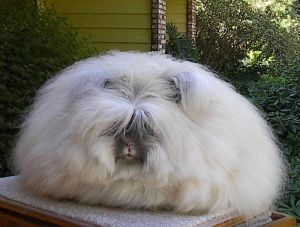
Angora:  downy coat produced by the Angora rabbit.
EnglishAngoraRabbit

Angora

 B

Batik: (n) a fabric printed by an Indonesian method of hand-printing textiles by coating with wax the parts not to be dyed; the method itself.
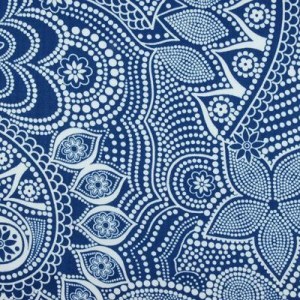
 

modern-outdoor-fabric

Batik


Bobbin: (n) a round object with flat ends and a tube in its center around which thread or yarn is wound.

Bobbinet: (n)  a machine-made net of cotton, silk, or nylon usually with hexagonal mesh.

Boiled wool: (n) created by a mechanical process using water and agitation, shrinking knitted or woven wool or wool-blend fabrics, compressing and interlocking the fibers into a tighter felt-like mass.

Bouclé:(n)  an uneven yarn of three plies one of which forms loops at intervals.

Brocade:(n) a cloth with a raised design in gold or silver thread.
stock-photo-1969339-brocade.jpg

Brocade

Bunting:(n) a lightweight loosely woven fabric used chiefly for flags and festive decorations.

Burlap:(n) a strong, rough fabric that is used mostly for making bags.

C

Calico:(n) a light, printed cotton cloth :a heavy, plain white cotton cloth
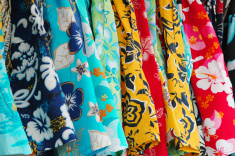
stock-photo-3532465-colourful-handkerchiefs.jpg

Calico

Cambric:(n) a light, thin, white linen or cotton cloth

Cashmere:(n) a fine wool from a kind of goat from India :a soft fabric made from cashmere wool.


Chambray:(n) a lightweight clothing fabric with colored warp and white filling yarns.

Charmeuse:(n) a fine semi-lustrous crepe in satin weave.

Chenille:(n) a wool, cotton, silk, or rayon yarn with protruding pile;also:a pile-face fabric with a filling of this yarn.

Chiffon:(n) a sheer fabric especially of silk.
stock-photo-3486596-veil.jpg

Chiffon

Chintz:(n) a shiny cotton fabric with a flowery pattern printed on it.

Cloth: a flexible material consisting of a network of natural or artificial fibres.

Corduroy:(n) a durable usually cotton pile fabric with vertical ribs or wales.

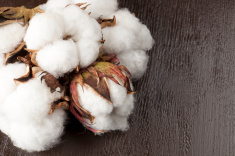
Cotton:(n) a soft, white material that grows on the seeds of a tall plant and that is used to make cloth;also: the plants on which this material grows.
stock-photo-47863284-wood-on-the-cotton.jpg

Cotton

Cotton gin:(n) a machine that separates the seeds, hulls, and foreign material from cotton.


Crêpe:(n) a thin often silk or cotton cloth that has many very small wrinkles all over its surface.

Crinoline:(n) an open-weave fabric of horsehair or cotton that is usually stiffened and used especially for interlinings and millinery.

Crochet:(v) a method of making cloth or clothing by using a needle with a hook at the end to form and weave loops in a thread.

D


Damask:(n) a thick usually shiny cloth that has patterns woven into it.

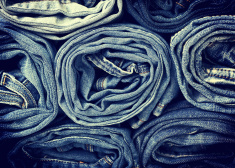
Denim:(n) a firm durable twilled usually cotton fabric woven with colored warp and white filling threads.
stock-photo-55897492-jeans.jpg

Denim

Double knit:(n) a knitted fabric (as wool) made with a double set of needles to produce a double thickness of fabric with each thickness joined by interlocking stitches: an article of clothing made of such fabric

Double weave: (n) a kind of woven textile in which two or more sets of warps and one or more sets of weft or filling yarns are interconnected to form a two-layered cloth, allowing complex patterns and surface textures to be created.

Duck:(n) (Dutch) also simply duck, sometimes duck cloth or duck canvas, a heavy, plain woven cotton fabric.

E

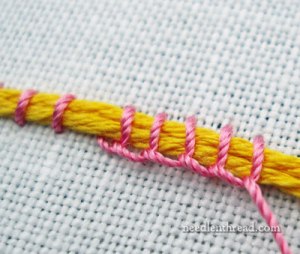
Embroidery:(n) the art or process of forming decorative designs with hand or machine needlework:a design or decoration formed by or as if by embroidery: an object decorated with embroidery.
couching-02

Embroidery

Embroidery floss:(n) a loosely twisted, slightly glossy 6-strand thread, usually of cotton but also manufactured in silk, linen, and rayon, and  the standard thread for cross-stitch.

F

Fabric: (n) any textile or cloth that is considered to be man-made.

Faille:(n) a somewhat shiny closely woven silk, rayon, or cotton fabric characterized by slight ribs in the weft.

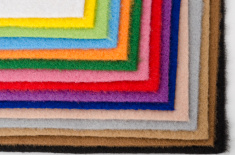
Felt: (n) a soft, heavy cloth made by pressing together fibers of wool, cotton, or other materials.
stock-photo-22113272-colorful-felt-plates

Felt


Fibre: (n) (Latin) a natural or synthetic substance that is significantly longer than it is wide.

Fishnet:(n) a coarse, open-mesh fabric.

Flannel:(n) a soft twilled wool or worsted fabric with a loose texture and a slightly napped surface: a napped cotton fabric of soft yarns simulating the texture of wool flannel: a cotton fabric usually napped on one side.

Fleece:(n) the coat of wool covering a wool-bearing animal (as a sheep): the wool obtained from a sheep at one shearing: any of various soft or woolly coverings: a soft bulky deep-piled knitted or woven fabric used chiefly for clothing.

G


Gabardine:(n) a firm hard-finish durable fabric (as of wool or rayon) twilled with diagonal ribs on the right side.

Gauze: (n) a thin often transparent fabric used chiefly for clothing or draperies: a loosely woven cotton surgical dressing.

Georgette:(n) a sheer crepe woven from hard-twisted yarns to produce a dull pebbly surface.

Gingham:(n) a clothing fabric usually of yarn-dyed cotton in plain weave.
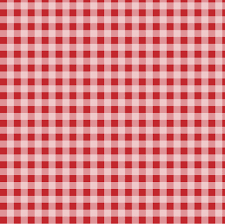
gingham.png

Gingham

Grosgrain: (n) a strong close-woven corded fabric usually of silk or rayon and often with cotton filler.

H

Haircloth: (n) any of various stiff wiry fabrics especially of horsehair or camel hair used for upholstery or for stiffening in garments.

Heather: (adj) refers to interwoven yarns of mixed colors producing flecks of an alternate color. It is typically used to mix multiple shades of grey or grey with another color to produce a muted shade (e.g., heather green), but any two colors can be mixed, including bright colors.

Hemp: (n) a tall widely cultivated Asian herb (Cannabis sativaof the family Cannabaceae, the hemp family) that has a tough bast fiber used especially for cordage and that is often separated into a tall loosely branched species (C. sativa) and a low-growing densely branched species (C. indica): the fiber of hemp.

Herringbone:(n) a pattern made up of rows of parallel lines which in any two adjacent rows slope in opposite directions: a twilled fabric with a herringbone pattern; also :a suit made of this fabric
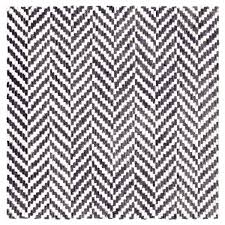
herringbone.jpg

Herringbone

Holland cloth: (n) a plain woven or dull-finish linen used as furniture covering or a cotton fabric made more or less opaque by a glazed or unglazed finish (the Holland finish).
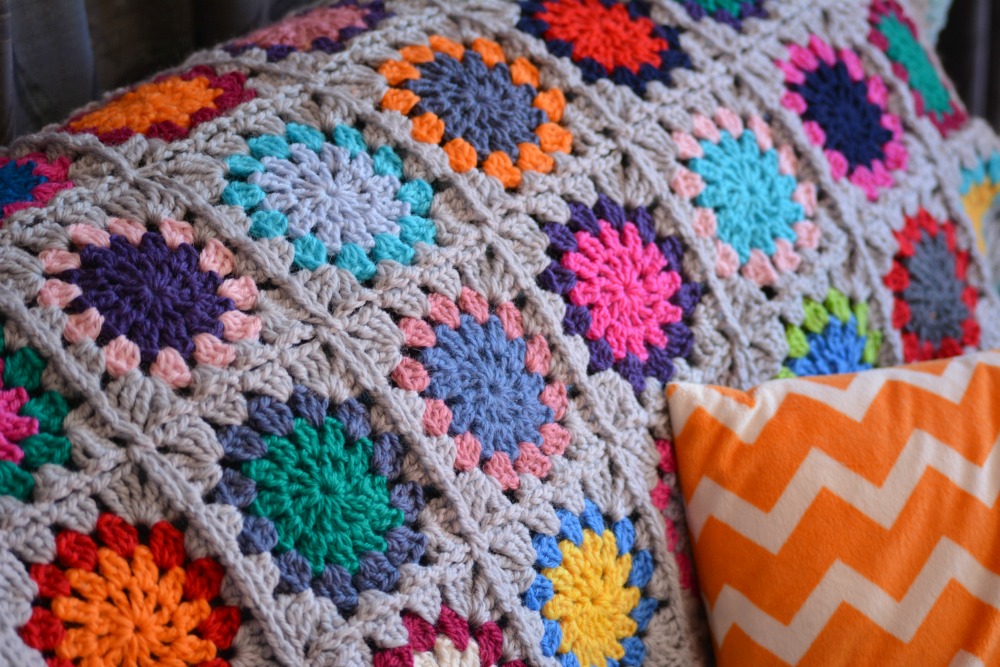
Houndstooth:(adj) a usually small broken-check textile pattern; also: a fabric woven in this pattern —called also houndstooth check, hound’s-tooth check.


I will be continually up-dating these posts with new terms, and, as the title of this post suggests, there will be two more ‘Glossary’ posts, for I-P, and Q-Z, so keep an eye peeled for those! Looking for a particular definition, term, or information that you don’t see? Leave your comments, questions, and requests below! I’m looking forward to hearing from you!

Until next time, Reader.

Yours,

Cotton Jenny


Darn that Denim

Hello again, Reader.

It’s been a while. I’ve missed you.

Things are settling into a rhythm here, and so I am back at the keyboard, where I belong.

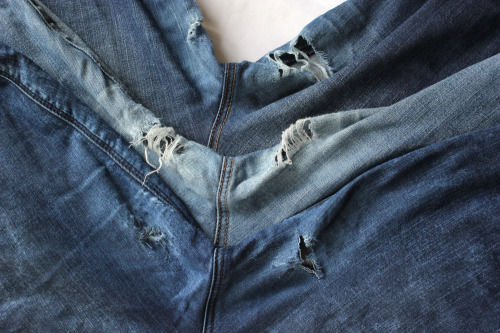
A few days ago, I was sitting in this very spot, working away, and as I crossed my legs, I heard a monstrous shredding sound. The fabric of my black jeans had torn: a gaping maw grinned at me from my upper thigh. My heart sank: a perfectly good pair of pants, ruined.

The horror!

The horror!

This often happens to older and well-worn pants when your thighs meet. The fabric rubs together, and wears down over time, so that eventually a hole develops, or as in my case, blows right through your pants in one fell swoop.

I was frustrated: I didn’t have the budget to buy a brand new pair of pants, and besides, I like these jeans. They are comfy, classic, and easy to dress up or down. I wear them a lot (which explains the hole). I did go out looking for a new pair, half-heartedly, but everything I saw paled in comparison to my wonderful black jeans. I admitted defeat, and put them in the back of my closet, mourning their untimely passing.

But a few nights ago, I came across instructions for darning, and after a little digging, discovered that it is possible to darn denim! I was so excited! Maybe my beloved black jeans weren’t for the bin just yet.

What I found, Reader, is that there seems to be two main ways to repair rips and tears in denim (and other cloth too). The first way is to get a backing fabric, like a stiff but lightweight cotton organdy, and use it as a little bridge between the two sides of the hole. Then you stitch over the fabric to join the two sides, with the backing fabric giving the stitches an anchor. Finally, you trim off the excess backing fabric, and voilá: your jeans are back to working order! This method works best if you have a sewing machine, because you can use the super-strong zig-zag stitch very easily, and the whole process takes little to no time, start-to-finish. You can find a full video of this process here.

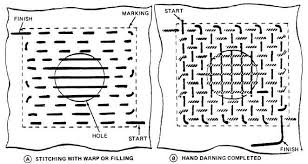
I do not have a sewing machine at the moment. So as excellent as this first method is, I am fixing my jeans the old-fashioned way: by hand. This second type of darning is more traditional, and is often associated with mending knitted garments like socks, but it can be used for a number of different purposes. To start, you trim off the excess threads around the tear, so that the edges are clean. Then you sew anchor lines parallel with the tear, starting just above and finishing just below the actual hole. Finally, you weave a threaded needle in and out of your anchor lines (weavers will recognise the anchor lines as warp threads, and the ‘fill’ as weft threads). What you are essentially doing is weaving and sewing at the same time. With every stitch, you are re-building your fabric. As such, it’s often best to use thread in a similar weight and fabric to your original garment. In my case, I have an easy time of things: my jeans are mostly cotton, and so a dense cotton thread, like a darning or embroidery thread, do the trick. I’m also lucky that my jeans are black, because colour matching is a breeze. If you are working on blue-jeans, or a patterned fabric, things can get a little more tricky. You have a couple of choices. Either pick a colour from your pattern, or match a thread as closely as possible to your fabric, to disguise where your hole was, or go for broke and get a contrasting colour to show off your darning skills and brighten up your garment.

Two steps to darning by hand.

Two steps to darning by hand.

I was thrilled to find out all of this stuff, for a couple of reasons. Firstly, I like the clothes in my closet. Some of them I have had for a very long time, and it would be a shame to toss them on account of a tiny tear. Furthermore, needles and thread are typically a lot less expensive than a brand new pair of jeans, so repairing damaged garments takes the pressure off my pocket-book. Finally, making do and mending means that fewer of my clothes end up in a land-fill, and that can only be a good thing.

Reduce, re-use, recycle...and now, repair!

Reduce, re-use, recycle…and now, repair!

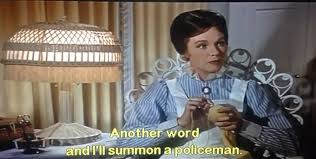
I mean, even Mary Poppins darns the odd sock. If it’s good enough for Mary, it’s good enough for me.

Mary Poppins means business.

Mary Poppins means business.

I’ll be sure to post pictures of my progress with my very first darning project, but for now, I’d love to hear from you! What have you mended/darned/fixed/repaired/up-cycled, and how did it go? Any handy hints you’d like to share? Let me know, Reader!

Until next time.

Yours,

Cotton Jenny

The Dress Code

Hello again, Reader.

I was planning a lovely post about embroidery stitches for today, but something has been weighing on my mind and gnawing at me, so the stitches are going to have to wait. Here’s the deal.

I was out for a walk yesterday with my boyfriend, on our way to dinner. We happened to walk past a group of four men, who seemed to be in their early twenties to me, but I didn’t stop to fact-check, so I’m not certain. As we overtook them, they hurled insults and slurs my way. I was startled and shaken. I have come to expect behaviour like that when I am alone or with other women, but never when I am with a man. That alone is a sad, and frankly abominable, state of affairs.

Even worse, Reader, was my reaction to this street harassment. I immediately glanced down to check what I was wearing.

I’m still deeply ashamed about this. No matter how much I decry it, I have bought into the idea that the clothes I put on my body invite particular responses from men, who are apparently unable to control themselves or their actions. According to this notion, the wretched behaviour I experienced is not men’s fault: it is my fault for wearing clothes that would entice or excite their brutish, animalistic natures.

This is called victim-blaming, and I’ve been seeing it discussed a lot recently. One article that caught my attention recently recounted the details of a case in which a young woman was ejected from her high school classroom, sent to the principal’s office, and then sent home, missing a day’s worth of education, because (wait for it)… her collarbones were showing. I’ll repeat that. Collar. Bones.

So shocking!

So shocking!

What’s worse is that the reason given in her school’s handbook for why collarbones are so inappropriate for the classroom is that they would be a distraction for male students.

There are several problems with this line of thinking. First of all, it puts the responsibility for any kind of aggression or violence towards women, big or small, on women. That logic doesn’t work in other situations: if you get mugged, it’s your fault, because you were carrying something. If your home is broken into, it’s your fault, because you have a house. If someone keys your car, it’s your fault, because you had a car to key in the first place. We don’t say these things to victims of theft or vandalism. We do say these things to women who get harassed, verbally or otherwise.

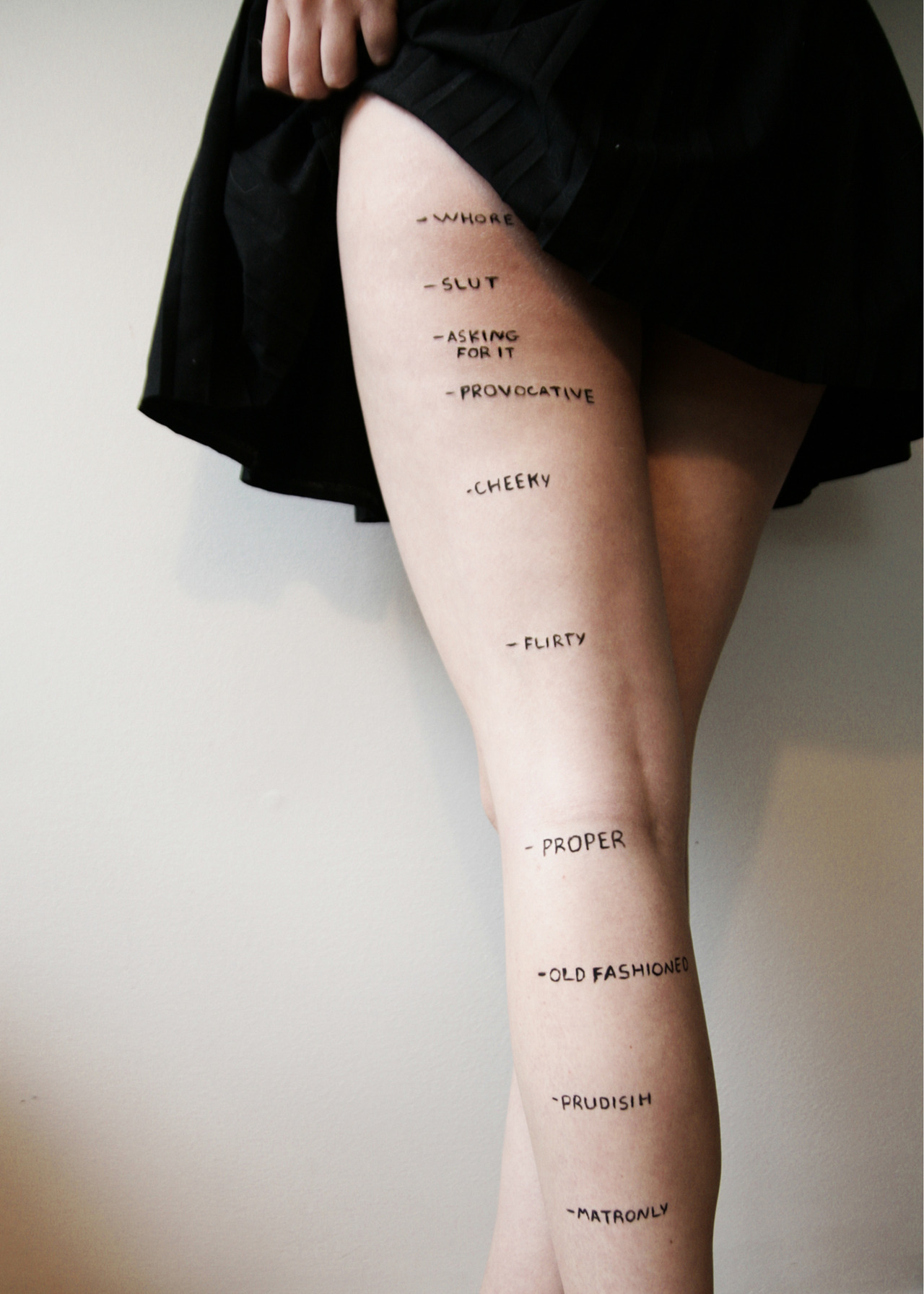
Secondly, it’s a fallacy that women who dress is an ‘appropriate’ way don’t receive aggression. Women in areas where dress is state-mandated and covers either all or most of their bodies still experience harassment from men.(Read more about it here.) Besides, what is ‘appropriate’, anyway? Some people would define what I was wearing last night as down-right prudish, while others would insist that because my wrists, ankles, hair, and face were exposed, that I was nigh-on inviting obscenities from these men. There is no set definition of ‘appropriate dress’, which is why schools have to make up guidelines. Doesn’t it seem odd that they have to invent rules to support the ‘rules’ they want their students to adhere to? If these rules are real, and should be followed, why don’t they already exist?

skirt-length

Now, some of you might be saying, “We agree that the collar-bone thing is a step too far, and we’re sorry that a bad thing happened to you, because we know you, but what about all those other women, who go around with their low-cut tops and short skirts and see-through fabrics and high heels? Surely those women are asking for whatever they get?”

Well, Reader, that’s a big old NOPE. Let me tell you why. For starters, this kind of dialogue between women is actually a tool to distance ourselves from those women whom society deems deserving of aggression, so that we don’t get mixed up with them and suffer their same fate. We shame and bad-mouth each other as a means of distinguishing ourselves as morally-upright, superior women who are beyond reproach, and to delude ourselves into thinking that we are safe from aggression from men. What we are really doing is throwing each other under the proverbial bus, and perpetuating the myth upon which victim-blaming is based: namely, that victims of harassment crimes are in any way responsible for their suffering.

Furthermore, dressing in a way that is deemed ‘sexy’ seems to have very little effect on whether or not a woman is harassed. All kinds of women get harassed, of all ages. I was harassed for the first time as a child of twelve. Harassment in any form isn’t about sex. It’s about power. The young men I passed on the sidewalk weren’t aiming to get to know me better, or even make a pass in the hopes that they’d get lucky. (We can be certain of this by asking ourselves one simple question: of all the couples you have ever known, how many of them met via street harassment?) They were showing off in front of each other, bigging up their own egos by making someone else (namely me) feel small. Similarly, men who cat-call by themselves aren’t trying to meet women. They are doing it for entertainment, for sport, to pass the time, and to make themselves feel good by asserting dominance over others.

All of this nonsense doesn’t put men in a very good light, does it? It makes them seem beastly, boorish, crass, insecure, immature, vulgar, and just plain rude. HIgh school boys, according to many dress-codes, are half-witted, animalistic brutes, unable to control their hormonal urges, and utterly enslaved by their bodies. There’s a name for this: it’s called toxic masculinity. Patriarchy doesn’t just have an impact on women. It also affects the way in which men experience life, and a lot of the time, not in a good way. From a young age, men are told that they have to be powerful, strong, aggressive, sexually virile, tough, insensitive, and unemotional to ‘count’ as a real man. Their positions as the dominant gender in our society balances on whether or not they can perform this role, and keep up the masquerade of toxic masculinity. We see examples of it all the time, but one of the most prevalent, and most dangerous, is in interactions with women. The young men who shouted at me were displaying dominance over me for the benefit of their friends, to show each other how masculine and powerful they are. This is the technique of the bully: to mask the feeling of insecurity, or to override it, they instill insecurity in others through aggression. But that’s just the problem. The aggression masks or overrides the feeling, but doesn’t deal with it, or make it go away. Toxic masculinity is bad for women and men.

Warning: may contain toxic masculinity.

Warning: may contain toxic masculinity.

So, long story short: my clothes, my shoes, my hair, my appearance, DO NOT invite aggression or harassment under any circumstance. As such, I will wear whatever I like, and enjoy wearing clothes that make me happy. I’m wearing them for me.

Also, a note to the distasteful ‘gentlemen’ who hollered unspeakable things at me:

The only kind of acceptable cat-calling is when you are actually calling a cat. Even then, the cat will be unlikely to listen to you, because it is a cat. I am not a cat, but, you will be amazed to learn, I am also not listening to you.

So stop it.

Until next time, Reader.

Yours,

Cotton Jenny

Summer Reading List

Hello again, Reader.

It’s been a while since I last posted. A major project of mine has just come to a close, and as usual, the last stretch is often the toughest. Suffice to say that I am grateful that it’s finished, and excited for what’s next, but also happy to call my time my own and dedicate a little more attention to the important things in life (like this blog, for instance).

It’s a sleepy Sunday, and in the interest of keeping it that way, and to ease back into the swing of things here at Cotton Jenny Fabrics, I’ve got a great little list coming your way, Reader.

I’ve been packing up for the big move that is coming at the end of this month, and in the process, came across some of my favourite books that deal with all things fabric, all of which I cannot recommend highly or often enough. Check them out!

8. Women in Clothes. Sheila Heti, Heidi Julavits, Leanne Shapton, et al. This is a fantastic collection of the results of an enormous, and yet remarkably intimate, survey carried out by the authors with over six hundred and thirty women of all ages, backgrounds, and experiences. The authors ask their subjects the same questions we often find ourselves mulling over in the morning as we stand, perplexed, before our own closets: how do these clothes make me feel? What is my favourite thing to wear? How have the opinions and feelings of others influenced how I feel about my wardrobe, and my body? These dialogues are interspersed with photographs and drawings, often of collections of garments (all the striped shirts owned by one woman; another’s collection of medical scrubs; a treasury of rings). It’s a sizable read, but due to the dippable nature of the surveys and interviews, it’s easy to get through, and begs to be re-read. The combination of these nutritious and delicious bite-sized morsels, and the surprising images alongside them, make this book reminiscent of the fascinating, funny, and frank conversations we have with our closest friends into the wee hours, teasing meaning from the tangled webs we weave.

Women in Clothes.

Women in Clothes.

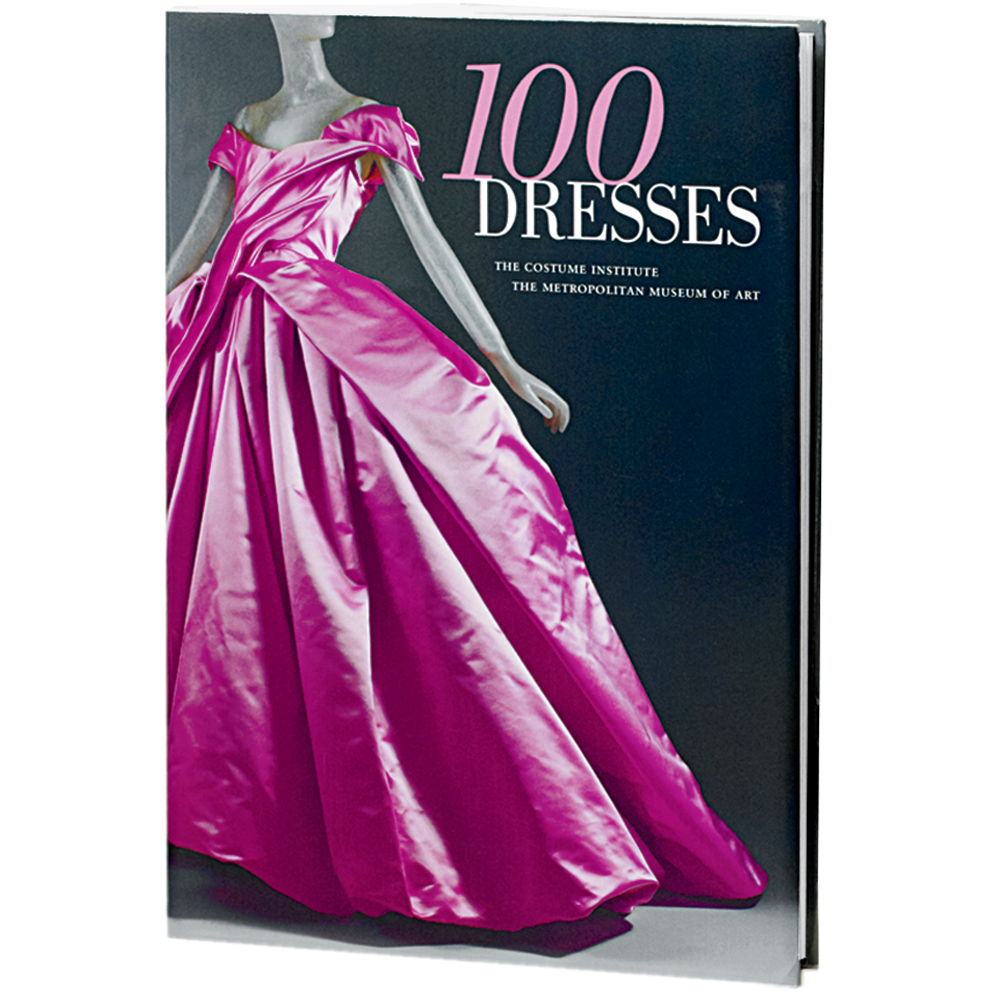
7. 100 Dresses. The Costume Institute at the Metropolitan Museum of Art. If you ever find yourself, as I often do, hungry for some substantial but stylish, sumptuous reading, then look no further than 100 Dresses. This book reads like a fashion magazine written by textile and fashion historians, which, come to think of it, is exactly what it is. One hundred full-colour photographs of the Met’s most famous and significant pieces from their costume collection are on display here, with delightful amuse-bouche write-ups, giving you just enough information about the dress and its salient points to whet your appetite, but not to overwhelm. They offer up examples dating back as far as the late seventeenth century, and continue into the present-day with contemporary examples. My personal favourites include Jean Patou’s 1931 hand-painted silk satin cape and dress, as well as stunning evening gown by Madame Grès in ivory pleated jersey from 1954-55. Incidentally, Reader, I spent several minutes poring over the pictures, trying to pick out a few examples to offer you, but it was difficult not to just tell you about each dress: in fact, I defy anyone interested in fashion history not to drool over every single garment equally. That’s the lovely thing about this book: you can lust after the delicious dresses while still feeling mentally nourished, because, after all, it’s historical, and that counts for something, doesn’t it?

100 Dresses

100 Dresses

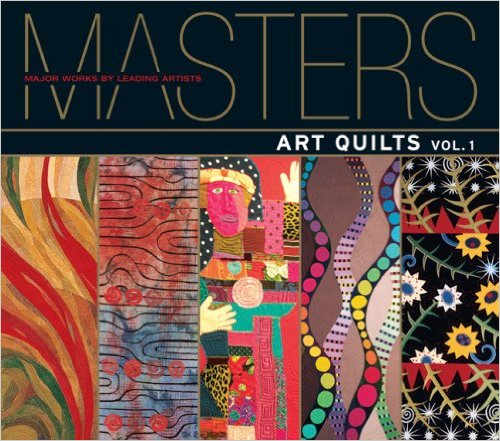
6. Masters: Art Quilts Volume 1 and 2. Edited and curated by Martha Sielman. I am certain, Reader, that you, like me, find yourself nearly daily in defense of quilting as an art form, and wondering to yourself, “wherever will I find documentation of great quilting artists to show people how great quilts are and what a great medium it can be?” Well, I am here for you, Reader, and so is this two-volume series. These books give an extensive list of works by artists from all over the world who work in quilting. Some of my favourite artists on offer here are Elizabeth Brimelow, Caryl Bryer Fallert, and Noriko Endo, Karin Franzen, and Dirkje van der Horst-Beetsma, among others. Each artist has a biography dedicated to them, as well as lots of examples from their oeuvre. It’s lots of fun to flip through, whether for inspiration, or simply to enjoy and admire the wonderful work of some of the quilting world’s best and brightest.

Masters: Art Quilts

Masters: Art Quilts

5. Heritage Quilt Collection. Agnes Etherington Art Centre.  Is there anything better than an exhibition catalogue? No, I thought not. They are like grown-up picture books, and ones that you can feel smugly proud of what you are reading, and be perfectly happy parading it before your friends and family. “Oh yes”, you say to them archly, “this is an exhibition catalogue.” They are duly impressed and you get to secretly enjoy looking at pictures and doing next to no reading at all, while still appearing deeply intellectual. This is one such book. There is a brief, cheerful introduction at the beginning, and the rest of the book is pretty picture after pretty picture. It’s also very lovely to have lots of Canadian content, and a celebration of Canadian women’s quilts. Perusing this book makes me feel deeply virtuous, and really, we can’t ask much more than that from our books. Unfortunately, this is a difficult book to get your hands on, so if you come across, nab it.

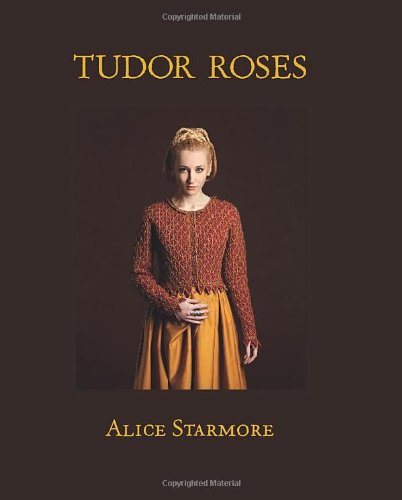
4. Tudor Roses. Alice Starmore. This is a fascinating book. Combining English history with knitting patterns might sound a little off-the-wall, but it’s a sumptuous, imaginative read, and an excellent well-spring of ideas for the avid knitter. The author has designed and executed gorgeous knitwear for the women of the Tudor court (thirteen in total), from Margaret Beauford to Anne Boleyn, and of course Elizabeth I and Mary, Queen of Scots are included. Jewellery was also designed specially for the publication. Each historical person is given a brief biography, which is followed by excellent knitting patterns and wonderful full-colour photographs showing the finished products to inspire the reader. This book makes a great work for avid historians and knitters alike. It’s artistic, intellectually stimulating, and quite simple, a very beautifully-executed book.

Tudor Roses

Tudor Roses

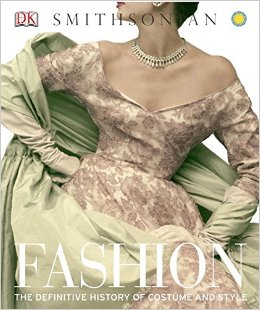
3. Fashion: The Definitive History of Costume and Style. Smithsonian Museum. This book weighs a tonne, so not only do you get a lovely read, but your biceps get a great work out as well. It’s one of those wonderful books that is substantial enough to lay open on its own, without you having to hold it open, which is delightful. But physical qualities aside, this is a wonderful book, and about as comprehensive as you could possibly want. It starts with ancient history and travels through to the present day, with oodles of drawings, photographs, and tasty little tidbits of information, but almost no long stretches of writing to slog through. Instead, there’s a kind of pastiche of wonderful bits of pieces, but it all ends up flowing together so that you see the changes and developments in fashion and dress as time goes on. One of the best things about this book is how chock-full it is of definitions. Don’t know what a peter-pan collar is? Here’s a definition, picture, and historical background for you. Want to know an accordion pleat from your a box pleat? Look no further. I go back to this book again and again to look up definitions and check my facts. So really, it’s not only a fun romp through fashion, it’s a factually accurate and deeply useful reference book.

Fashion: The Definitive History of Costume and Style

Fashion: The Definitive History of Costume and Style

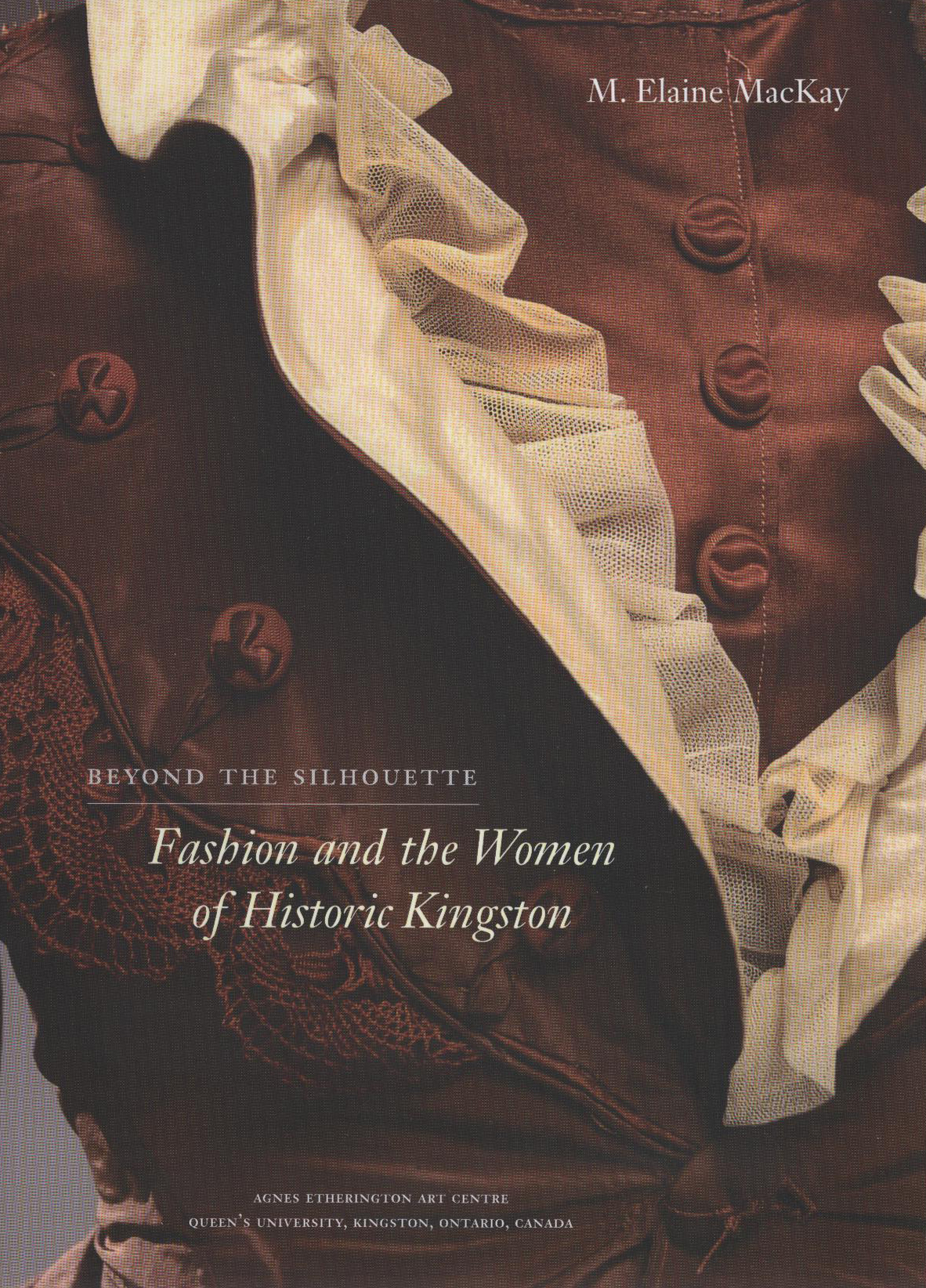
2. Beyond the Silhouette: Fashion and the Women of Historic Kingston. M. Elaine MacKay. This is a short but delightful morsel of women’s fashion in Kingston, Ontario. There’s a nice balance here of text and image, but one of the things I love most about this book is that the images provided are two-fold. Each garment is shown in full, but also in detail, so you can see the detail of the surface treatment, say, or the cunning buttons on a blouse, close-up and personal. The writing is cheerful and rollicking, and the garments and gowns are so pretty, you can’t help but go away from reading this book with an improved mood, and a strange desire to wear hoop shirts and ruffled blouses.

Beyond the Silhouette

Beyond the Silhouette

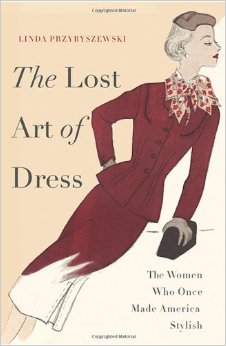
1. The Lost Art of Dress. Linda Przybyszewski. I think this may be one of my favourite books. Not just favourite textile/fashion books: just one the best ones, period. The author is fierce, fiery, and funny, and deeply knowledgeable about her topic. This is a call to arms/ obituary/ historical narrative detailing the rise and fall of home economics in the United States, and the “Dress Doctors” who led the charge. Here you can find at once cheerful fan-girling, imperious and shrewd advice, and mournful recollections of days past, as well as great, helpful dress and dressing tips, some of which you can find here. This is a great book for travel, and excellent inspiration for those of us frustrated with buying, keeping, and wearing clothes, and certainly would make excellent fodder for righteously angry seamtresses’ flames. Strangely, I found it extremely useful to read this book immediately before clearing out my closet, Przybyszewski’s cheerful but clear-headed voice ringing in my ears. I cannot recommend this book highly enough. Read it. Please.

The Lost Art of Dress

The Lost Art of Dress

I hope something here has tempted your appetite, Reader. I know it has mine: I’ve purposefully kept these books out of the packing boxes, so I can go through them again a few times before moving day arrives. It cheers me to think that you might be reading them alongside me one of these days.

Until next time, Reader.

Yours,

Cotton Jenny

Doily Dear

Hello again, Reader.

In my hall closet is a box of odds and sods. It’s mostly fabric scraps, but there is also a collection of doilies from my grandmother’s house, which made their way to me a few years ago. They’ve been sitting in my closet for quite a while now, and recently, I was inspired to do something with them. So I fired up the old Google, and hunted for interesting ideas.

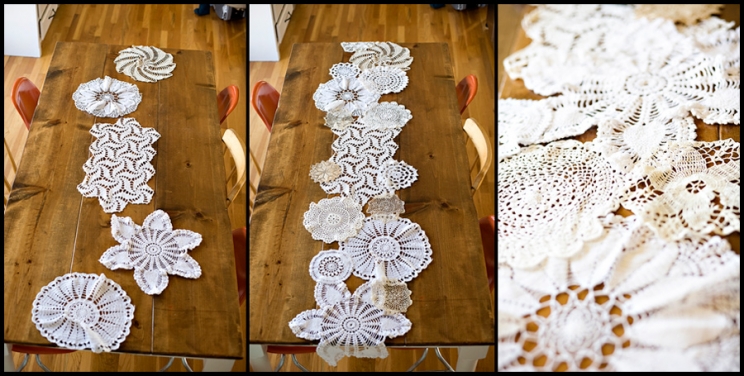
Doily table runner

Doily table runner

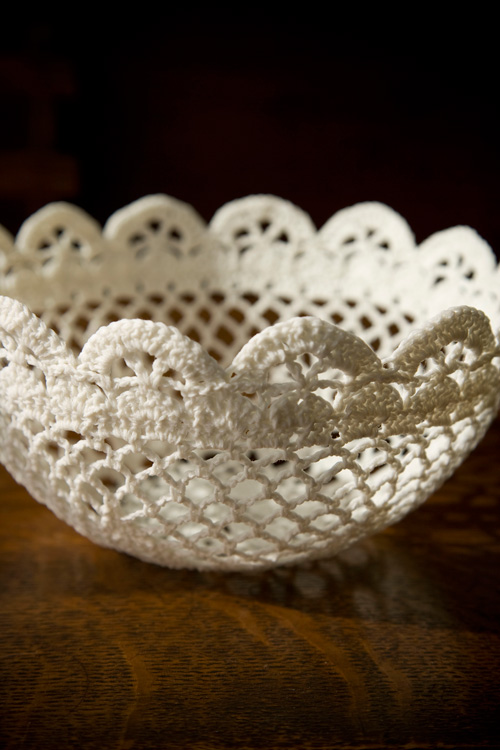
I found some pretty nifty notions, but there were three I liked the look of best. The first is a table runner made of crocheted doilies (just like the ones in my closet) sewn together. The second is a bowl made from a stiffened doily. The versions I saw indicated that you should harden it with glue or Mod Podge, but the image of the finished product reminded me of the lace bowls my god-mother places around her house on Christmas Eve. She soaks hers in water and cornstarch, and then fits them over a jar or bowl, and when they dry, they stand up on their own. The nice thing about doing it this way is that you can wash the starch out of the lace, at which point you can store it flat to be brought out again the next time you want to use it.

Lace bowl

Lace bowl

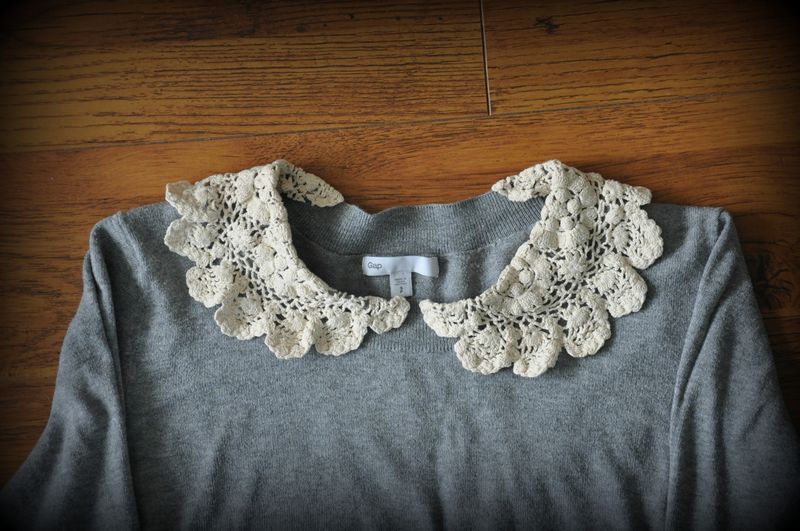
The third one I dug was perhaps a little more involved, but very pretty. A large-enough doily would make a delicate and dainty collar on a blouse or sweater. You could alter it to make it a peter-pan collar, or just leave it as-is for a simpler version. I love this idea. All these projects made me anxious to get stuck in to my own work!

A cute collar: prim, preppy, and pretty!

A cute collar: prim, preppy, and pretty!

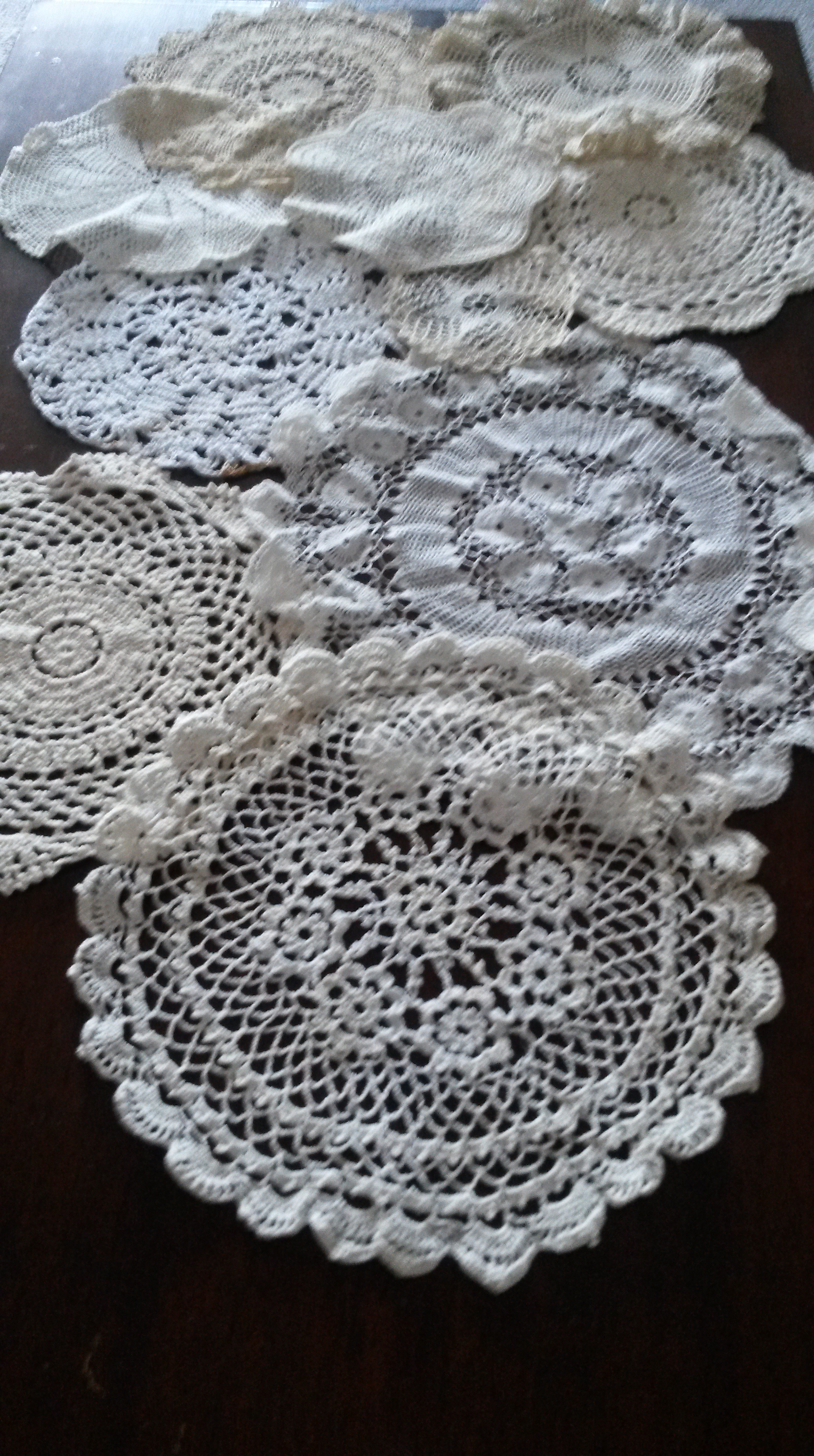
So, out came the doillies, and my needle and thread. Here are the doilies I chose to use: they are all roughly in the same colour palette, and I like that they vary a little bit in size.

Spots of lace: they remind me of snow.

Spots of lace: they remind me of snow.

What I ended up doing was laying them out in the order I wanted, and then simply stitching the edges together by hand. I found I liked the look best when I placed the biggest ones down first, like a kind of foundation, and then added the smaller ones on top. It seemed more balanced and visually pleasing to me to do it that way than to simply line them up and hope for the best. I also liked the look of off-setting them, so that they aren’t centred or in a straight line.

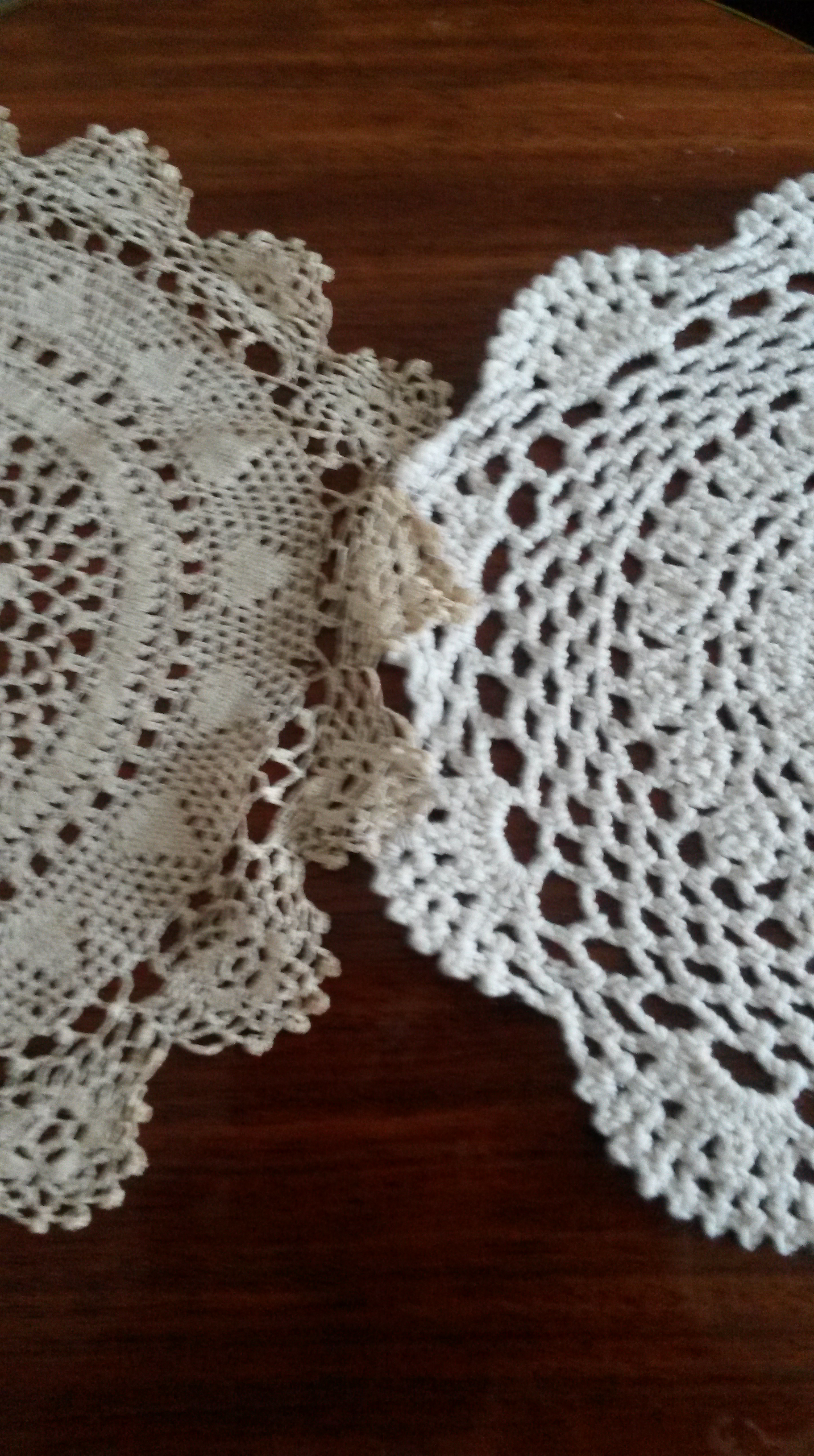
Simple tacking joins do the trick here.

Simple tacking joins do the trick here.

Now, it goes without saying that if you wanted to speed up this process, a sewing machine could certainly help. I don’t currently have access to a sewing machine, so hand-sewing it is! The whole job took me about thirty minutes, but most of that was arranging and re-arranging the doilies just so. The actual sewing was over in a flash.

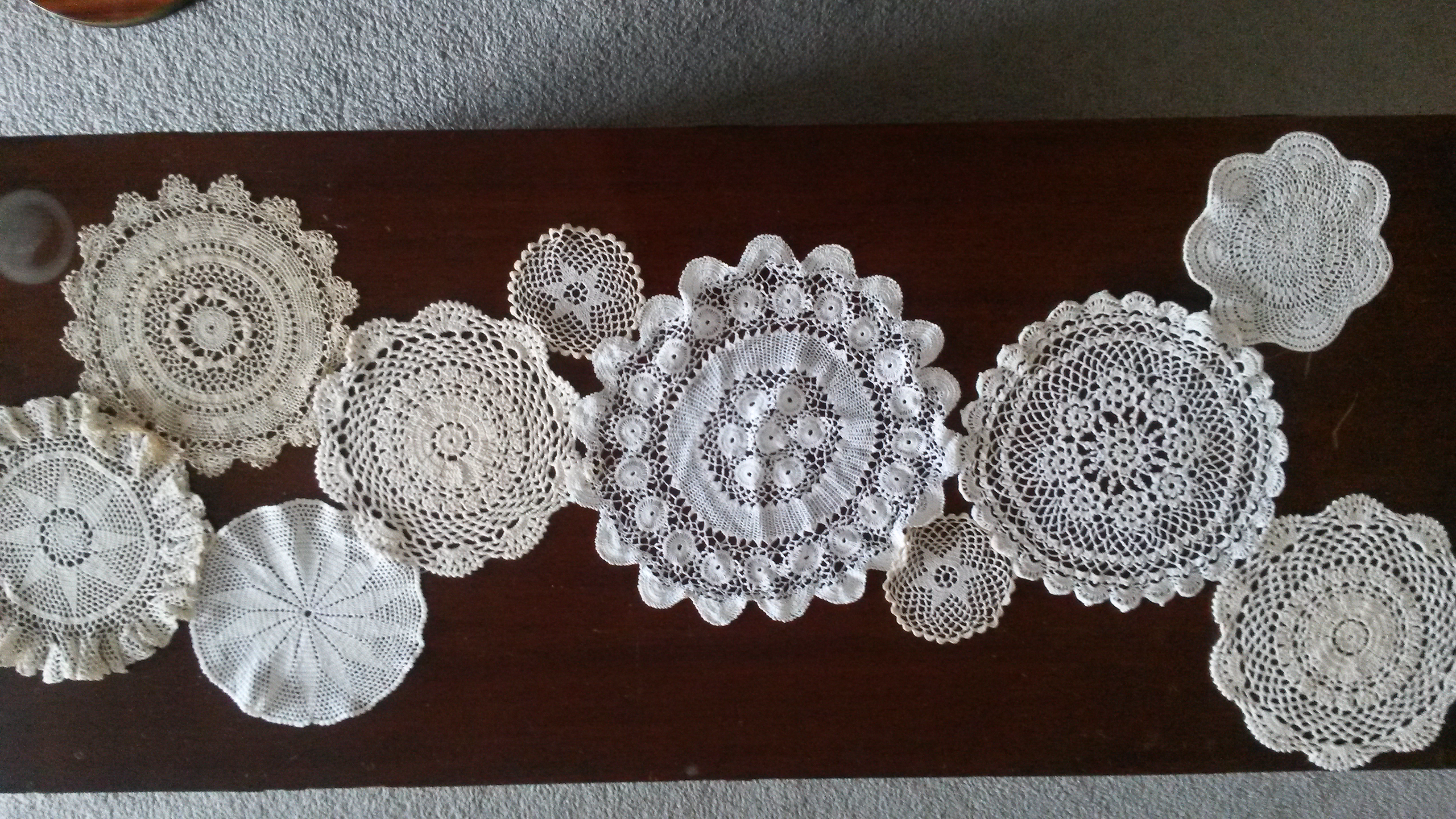
All done! (For now.)

All done! (For now.)

Here’s the finished product. The nice thing about a project like this one is that you can add to it very easily. Actually, removing doilies would be pretty simple too: the stitches are basically just tacking the doilies together, so it would be a cinch to take them out and start again, or just make adjustments. You can add or subtract as many or as few doilies as you wanted to fit the table you’re using. Be warned, though: if you hand-stitch these together, the finished result is going to be fairly delicate. It’s best to machine sew these babies if you plan to put the runner in the wash.

These might make a nice addition to a plain table, and would likely work a treat on a table at a rustic/DIY/country wedding. They’d also be a nifty appliqué, if that’s your thing.

Do you have any favourite doily-inspired projects? I’d love to hear about them: leave me a comment! Bonus points for pictures!

Until next time, Reader.

Yours,

Cotton Jenny

Sheep Thrills

Hello again, Reader.

After my last post, which was all about knitting (read it here), I got the knitting bug and took up my needles again after what had been kind of a long break. I have a big bowl of wool in my living room, filled to overflowing with balls of yarn. Some of them are really, really lovely wool, and others…well, let’s just say they leave something to be desired.

Mostly, the yucky yarns are synthetic. They stretch too much or not enough. They unravel. Worst of all, they feel sort of scratchy and hard, like they are made of plastic. (Likely because they are plastic.)

The nicest skeins, though, are natural fibres. I think my current favourite is beautiful alpaca wool from a local farm in my area. Each skein from this farm comes with a picture of the alpaca from whom the wool was harvested. They are adorable, but they always look slightly grumpy. Maybe it’s because they know I have their wool.

Wool, by the way, despite the fact that we throw this term around to mean a lot of different things, has a very particular meaning. Wool is the soft, wavy or curly and usually thick undercoat of various hairy mammals made up of a matrix of keratin fibers and covered with minute scales. That’s a very fancy way of saying that wool is curly, made of keratin (the same stuff as your fingernails) and comes from fuzzy, fluffy, furry animals. But we use this term to apply to those animal fibres we use to produce a twisted strand ideal for knitting, crochet, or weaving.

Anyway, I was thinking about all of these different types of wool, and thought “Hey! I love a good list!” So for a little easy reading on a lazy Sunday, here is:

An Unordered List of Wool Types

10. Synthetic Wool. Scratchy and weirdly stretchy, or not stretchy at all, these yarns are cheap, but sometimes, you get what you pay for. These yarns may be comprised of a wide variety of different synthetic or natural fibres in different percentages. Some are better than others, but on the whole, my experience with this type of wool has been pretty hit and miss. (Mostly miss.)

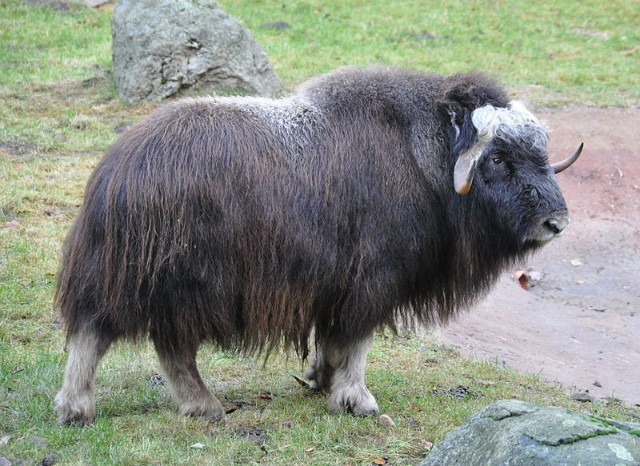
9. Quivit. This one may be harder to come by if you don’t happen to be neighbours with a muskox, because that’s where quivit wool comes from. It’s pretty nifty stuff: unlike other types of wool, it doesn’t shrink in water, no matter the temperature. While this means that it’s impossible to shrink down your favourite quivit sweater, it also renders quivit useless for felting.

Fluffy majesty.

Fluffy majesty.

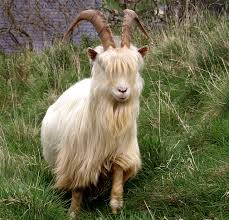
8.Cashmere. This luxurious wool comes from goats, and was developed in the Kashmir region of India (hence it’s name.) This wool is strong, light-weight, and quite a bit softer than regular wool.

kashmir

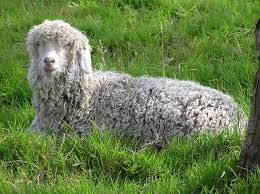
7.Mohair. This is made from Angora goat hair.It’s durable, shiny, and hardy against wear and tear. When treated properly, mohair can last a long time: these qualities have earned it the nickname “the diamond fibre.” It also takes on dye particularly well, making popular for textile design and clothing manufacture alike.

angora

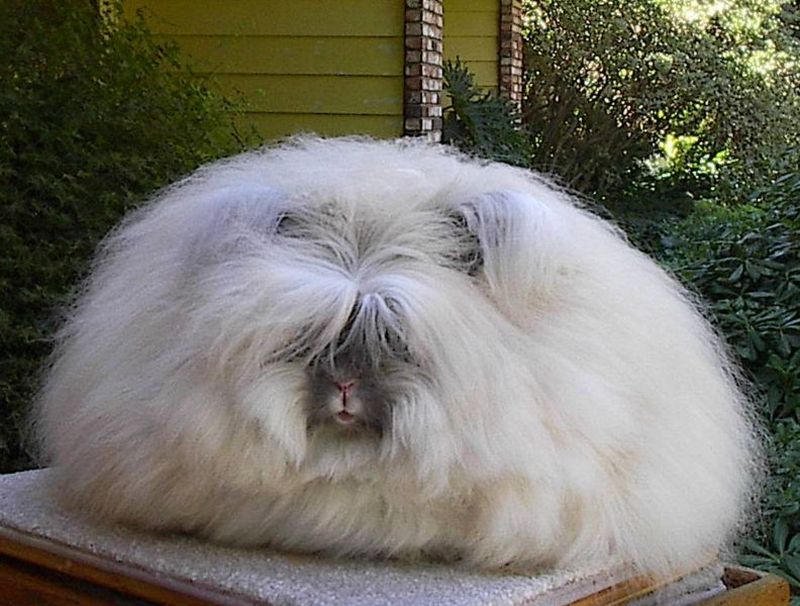
6. Angora. Not all wool comes from barnyard animals. Angora is made from rabbit fur! (Not from Angora goats. Confusing? Yes. Yes it is.)  It is characterised by its softness and a kind of fluffiness known as a ‘halo’. It’s called that because the fibres sort of seem to ‘float’. Because of this fluffiness, Angora wool tends to felt very easily: felting can even occur on rabbits who are not properly groomed.

Frighteningly fluffy.

Frighteningly fluffy.

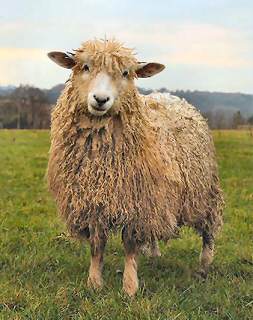
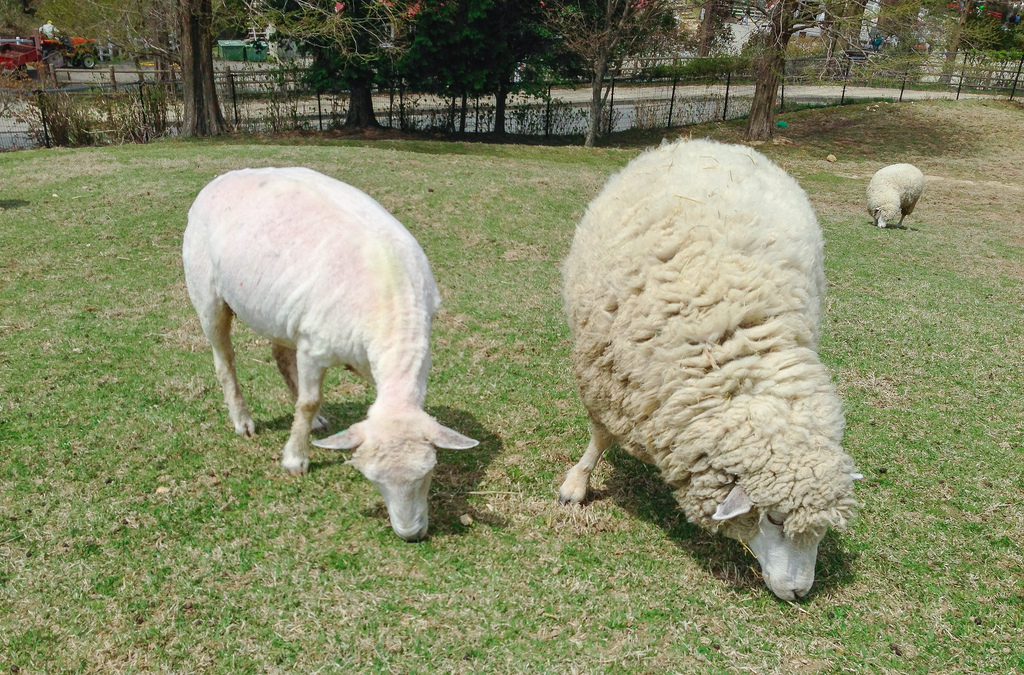
5. Sheep’s wool. This one is a pretty big category. There are so many breeds of sheep, and each one produces different kinds of wool. Sheep farmers have bred their flocks for distinct characteristics to achieve these differences, as well as shearing their sheep at different times throughout the year, and in the sheep’s life, to produce different effects in the wool. Some well-known types are Merino, Cotswold, Shetland, Hogget, and Karakul, to name a few.

Hello, friend!

Hello, friend!

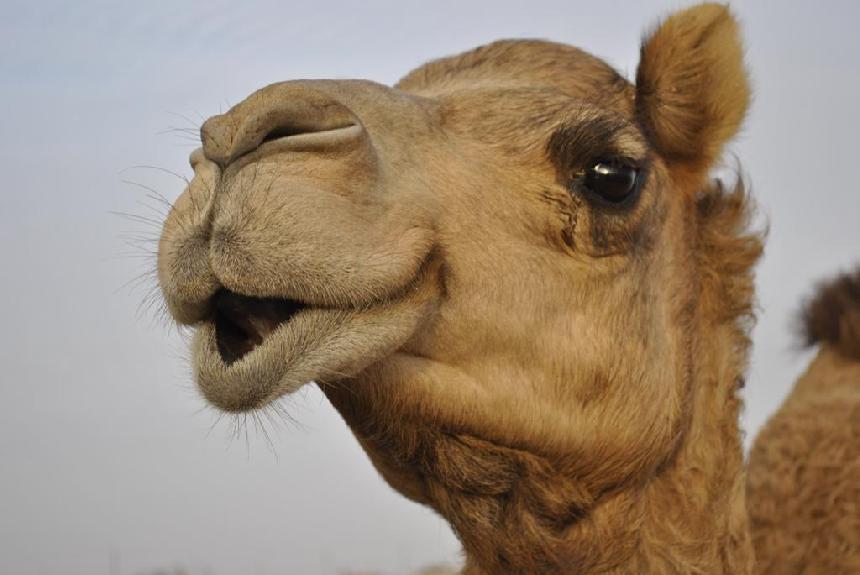
4. Camel Hair. Camels have two layers of hair making up their coats. One is the outer guard layer: it’s hard, coarse, and inflexible. It can be blended with other wools to soften these qualities. The undercoat of a camel is soft and fluffy, and is gathered when a camel molts, or sheds.

ATBCamel4

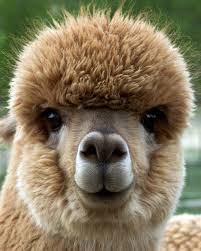
3. Alpaca fleece. The soft, dense fibre harvested from the alpaca (a camelid relative of the llama) is notable for its durability and silky texture. There are two main types of alpaca wool: huacaya has a natural crimp, making it ideal for knitting or crochet. Suri has no crimp, and is thus better suited to weaving. Both kinds are flame and water resistant, and have no lanolin, making this wool hypoallergenic.

You want to go on a picnic? Alpaca some lunch.

You want to go on a picnic? Alpaca some lunch.

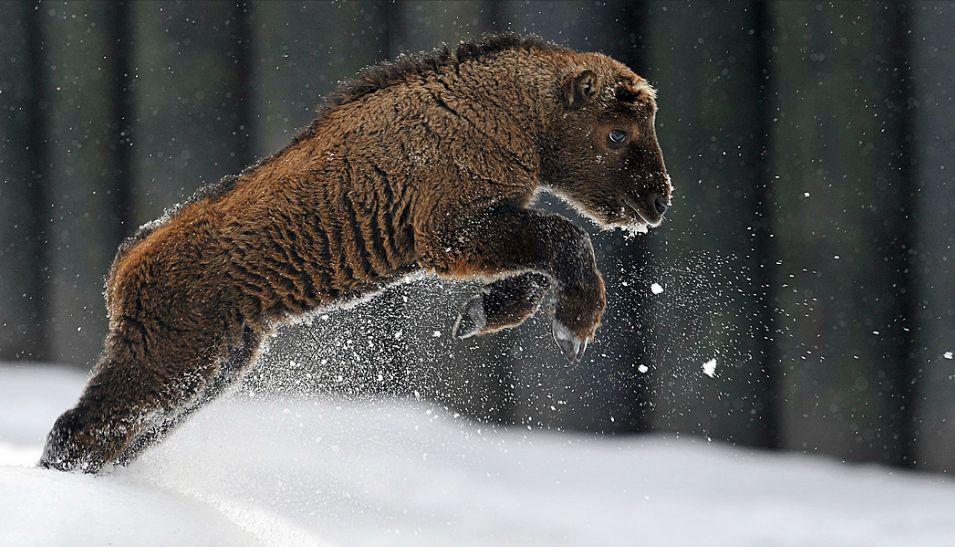
2. Bison. Like the camel, American bison have two types of hair in their coat; a soft under-layer next to the skin is guarded by protective, coarse hairs which make up the outer layer. Both fibres can be used to make wool. The bison sheds its fluffly under-coat once a year, just like the camel does.

He's almost as excited about wool as I am.

He’s almost as excited about wool as I am.

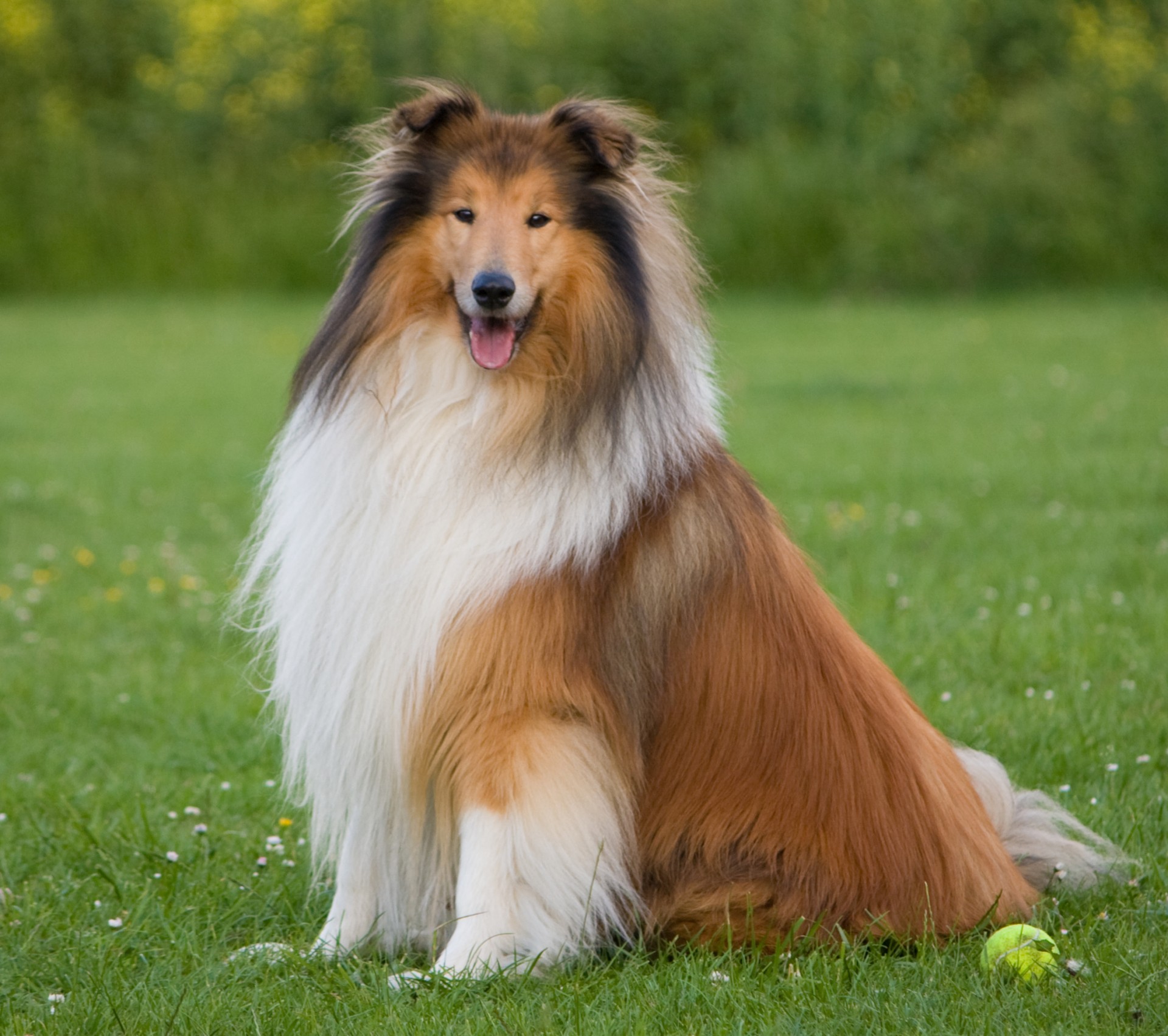
1. Domestic pet wool. Yes, this is a real thing. This type of wool is unique and unusual, and often considered a particular or niche product. (This is me trying to avoid out-and-out saying that it’s weird.) Nevertheless, dog and cat hair can be used as yarn. Obviously, the longer the hair, the better, so fluffy breeds like the collie or the Persian make ideal candidates.

Care for a little woof in your wool?

Care for a little woof in your wool?

An important note: harvesting wool from an animal is NOT meant to harm it. Shearing, or the process of removing hair or wool from an animal, is not only supposed to be a painless experience for the little critter involved; in many cases, shearing actually helps the animal. Many breeds of sheep are sheared during the hottest part of the year, so that they can chill out and stay cool in the heat. Some animals, like bison and camels, naturally shed their undercoat, so shearing them is just speeding up a natural process. Farmers take this stuff pretty seriously: there are sheep shearing competitions worldwide, and a big part of being an expert sheep shearer is doing the job as quickly and safely for the animal as possible, to reduce stress and prevent injury.

The before and after photo.

The before and after photo.

So we can feel good in our woolies, whether they come from camel or cat. If you’ve never tried working with some of these different wools, I say, give it a go! You never know what exciting results might await you. If you are familiar with these different fibres, I’d love to hear from you. What are your favourites, and why? Leave me a comment below!

Until next time, Reader.

Yours,

Cotton Jenny

Knit It!

Hello again, Reader.

I’m a big fan of the BBC programme QI, and I recently watched an excellent episode from their K Series called “Knits and Knots.” (Watch it here.) On this episode, Stephen Fry and Alan Davies, along with Ross Noble, Sue Perkins, and David Mitchell, delve into the fascinating world of knitting and knotting, as well as other topics beginning with a silent ‘k’.

Now, I knit quite a lot, but mostly, I knit to relax. There’s something soothing about the repetition, the gentle clickety-clack of the needles, and the memories of my grandmother teaching me to knit as a little girl that makes the whole process very calming for me. As a result, however, my knitted projects tend not to be especially complex or adventurous. But’s that’s more about me than it is about knitting itself. Because knitting can produce some pretty incredible things. “Such as?” I hear you asking, Reader. Well, read on!

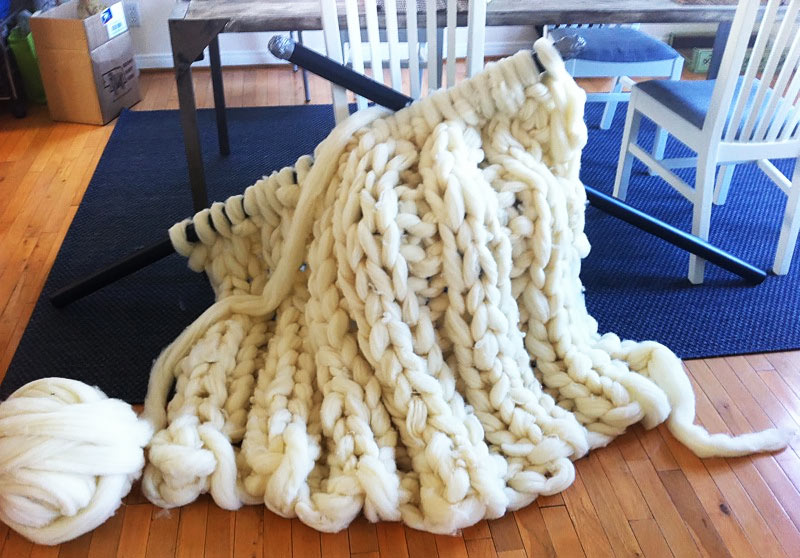
Go big or go home!

Go big or go home!

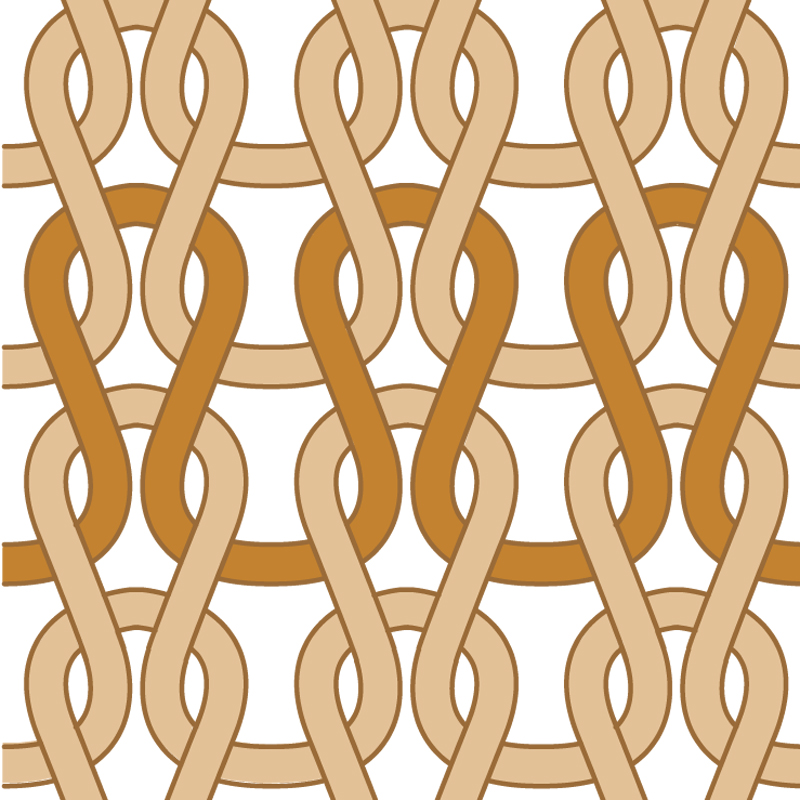
A growing trend in the world of knitting is large-scale projects. Giant needles, arm- and hand-knitting, and enormous yarn results in gargantuan examples of knitted objects. This process often focuses on the texture of the material, because the individual stitches are so large. It also shows off the construction of the knitting piece itself. Knitting, by the way, is a series of inter-twined loops made from a single yarn or strand.

97-know-knits-06

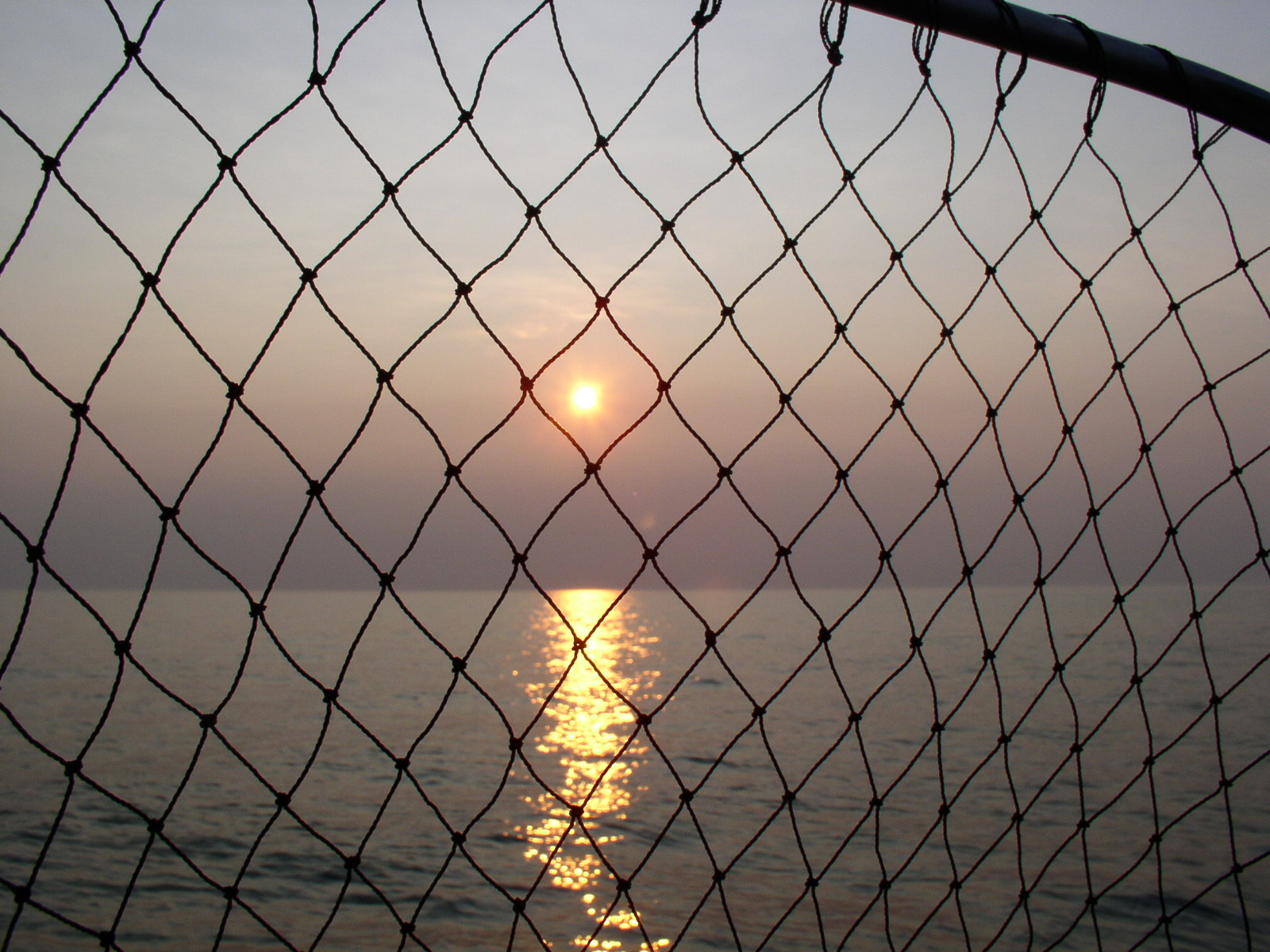
Actually, we can find this kind of construction in other, unexpected places. The loops of knitting are related, perhaps distantly, to the hitches and bends of sailors and the outdoorsy set. Speaking of sailing, early fishing nets were made by hand, using a series of connected partial loops, even though their present day descendents are more likely to be machine-made. Looks suspiciously familiar, no?

Catching some sun.

Catching some sun.

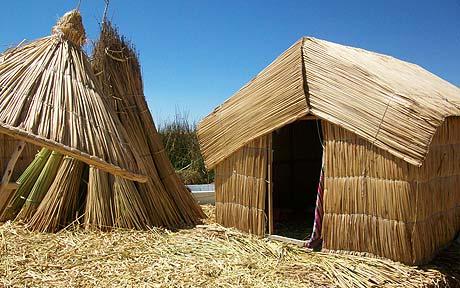
We can find other examples of knitting on a big scale besides giant needles and fishing nets. The islands of Uros in Lake Titicaca, Peru, are floating reed islands, which have been ‘knitted’ by their inhabitants. Apparently, the texture of these floating islands is so unique that people who live on them find walking on dry land very difficult. Not only have the reeds been built up to create spaces for people to live on, but their houses and buildings are also made of reed. A significant part of their environment is textile: it’s pretty nifty!

reed-houses-on-uro_1002576c

There are many outside of the Uros islands, however, who feel that they aren’t getting enough knitting in their lives. Enter guerrilla knitting, also known as knitting graffiti, kniffiti, or yarn-bombing. Avid knitters and other trouble makers add knitted goodness to their communities, and nothing is safe from their textile tyranny: trees, parking meters, bridges, lamp-posts, and even whole cars get the treatment. In some places, it’s meant to deter crime. In others, its a form of vandalism. Some might see it as the critical intervention of ‘craft’ in unusual locations. However you want to think about it, it’s fascinating, and often stunningly beautiful.

Tree-cozy.

Tree-cozy.

Speaking of gnarly knitters: there is a book that I treasured as a child, called The Secret of Platform 13, by Eva Ibottson, which I cannot recommend highly enough. There happens to be a very old lady in that book called Doreen, who works as a body guard for a rather nasty lady called Mrs. Trottle (but that’s neither here nor there.) What is so peculiar about Doreen is that her weapon of choice in her work as a body guard are her razor-sharp knitting needles, which she keeps on her person at all time. Now, this is not meant as an endorsement for using your knitting needles as weapons, Reader. I just think it’s sort of interesting that the author thought of using knitting needles, which are often seen as pretty feminine and harmless, as quite dangerous tools for this frankly unsettling character. Although, now that I think of it, the inimitable Miss Marple (heroine and detective extraordinaire from the brilliant mind of author Agatha Christie) also knits a great deal. Maybe we have been underestimating knitters all along.

So whether you want to make your world knitted, fill your city with yarn-bombs, or just knit big, this method of making a fabric has you covered. If, however, you are like me, and knit to un-knot your brows and your brain, then tally-ho, Reader! Either way, I hope this little romp has you inspired to get knitting and dream big. Or little. Whichever way you like it.

Until next time.

Yours,

Cotton Jenny

Crochet Coral Reef

Hello again, Reader.

In my first year of university, I had to take a maths credit course. Everyone warned me away from statistics, and I knew that calculus or algebra and I were not going to get along (thanks to our failed attempts at relationships all throughout grade school). I reluctantly signed up for the least offensive sounding course on offer: Math in Art.

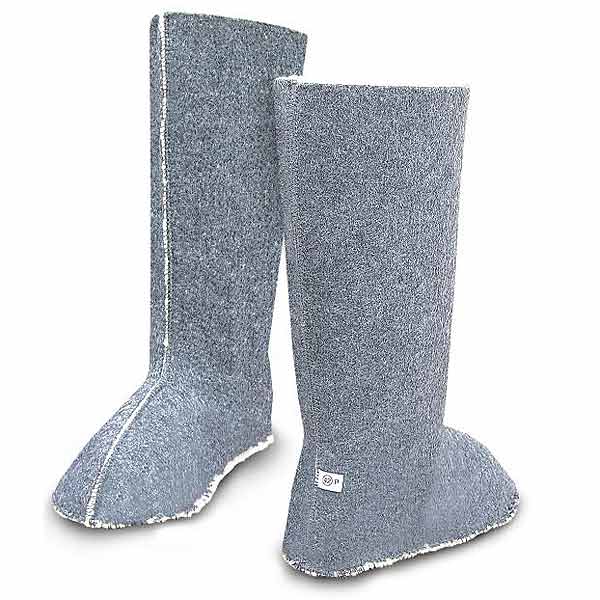
It was taught by a soft-spoken Russian professor, who made jokes about Donald Duck that no one understood, and a very peculiar teaching assistant. He was friendly, but he had a very intense personality, and he wore the felt liners of his winter boots in the class as though they were slippers. You could hear him swish-swish-swishing on the floor as he padded around at the front of the room, teaching us about rotations.

Swish swish swish!

Swish swish swish!

I digress.

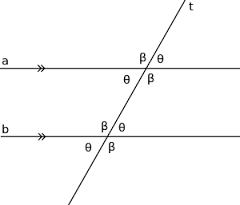
It was in this class that I first learned about hyperbolic geometry. Hyperbolic geometry is a kind of non-Euclidean geometry. Euclidean geometry asserts that, in two-dimensional space, for any given line a and point β not on a, there is exactly one line through a that does not intersect b; i.e., that is parallel to b. I don’t really know what that means either, but here’s a picture. Best of luck.

euclid

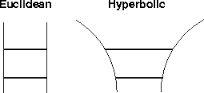
Hyperbolic geometry is non-Euclidean though, so this statement doesn’t apply. In a similar situation,hyperbolic geometry indicates that two distinct lines which pass through a don’t pass through bHere’s another picture.

hyperbolic

I wish I could comment more intelligently on the maths, reader, but I can’t. I’m sorry.

What I can talk about, however, is crochet.

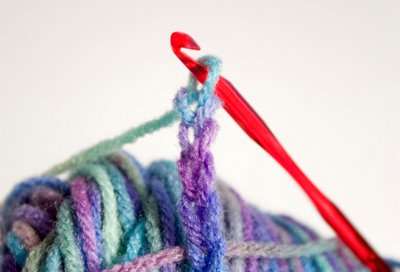
Crochet is a method of producing a fabric by linking together the loops of a single yarn or strand.There are all kinds of different crochet stitches, but they all function on this same basic principle. We usually think about crochet and imagine baby-blankets and afghans on our grannies’ couches.

So cozy! So stylish!

So cozy! So stylish!

Now you might be wondering how hyperbolic geometry and crochet are remotely related. Get excited, Reader: I am here to tell you.

Although hyperbolic geometry was developed and proved in the nineteenth century, it was nearly impossible to actually physically express it until very recently. Mathematicians thought about hyperbolic geometry as an abstract concept, not a physical reality. Even after the advent of computers, describing hyperbolic geometry still proved to be very difficult, which meant that for a long time, it was essentially a theoretical branch of mathematics.

A Latvian professor, Dr. Daina Taimina, first used crochet to express hyperbolic geometry in 1997. She saw her colleagues struggling to make flimsy and inaccurate paper models of hyperbolic planes, and decided to make more durable and accurate examples in wool. (What a smarty-pants.)

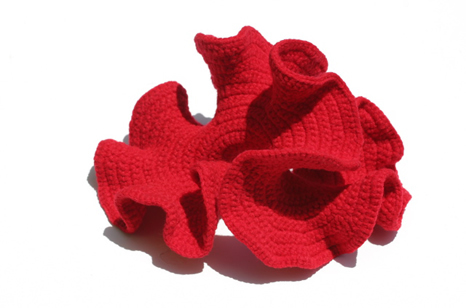
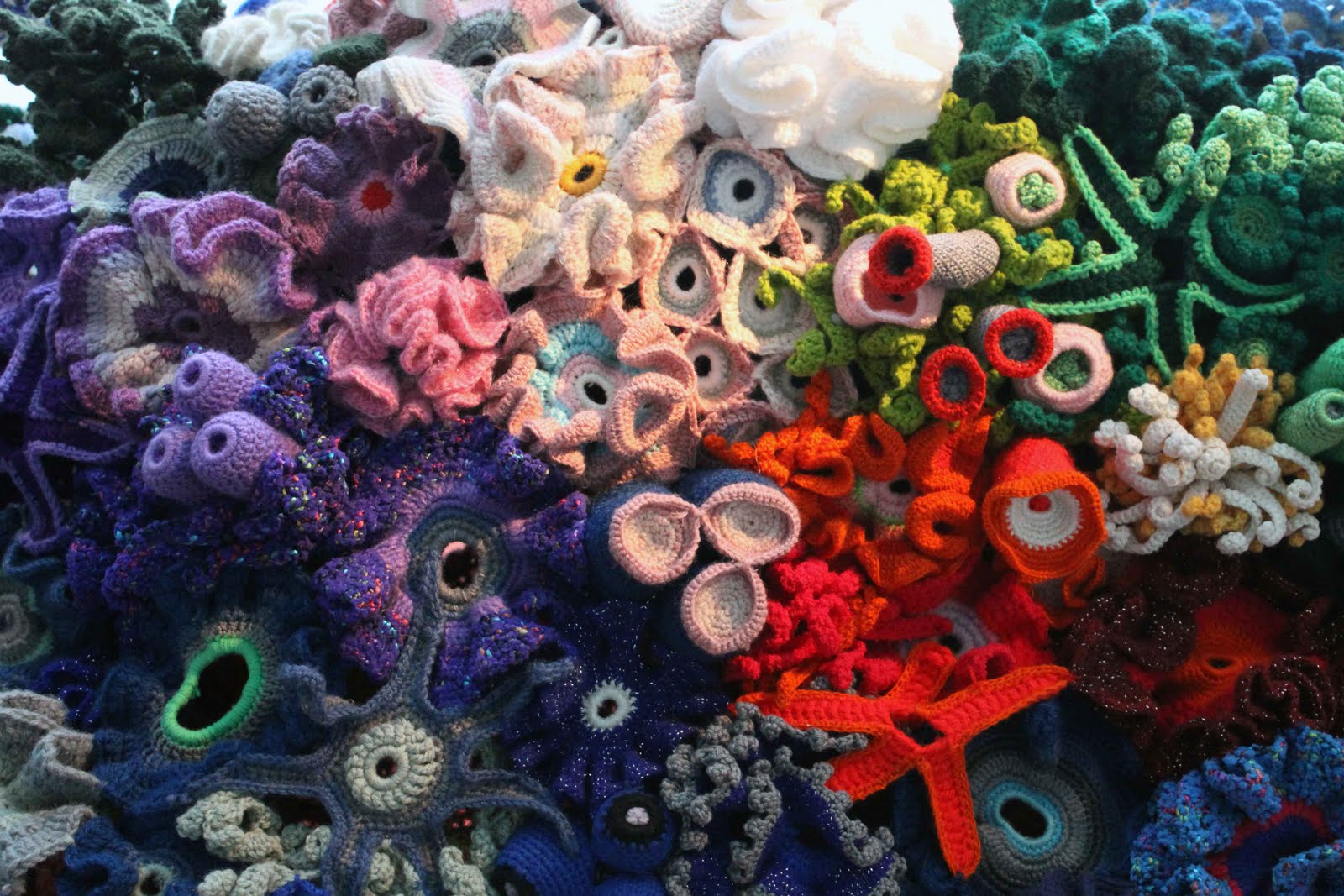
This idea was picked up by two Australian sisters, Christine and Margaret Wertheim. Margaret is a physicist, and Christine is an artist. As much as wool and water don’t normally mix well (think about the feeling of wet wool socks, and you’ll know what I mean) they realised that crocheting replicas of coral reefs actually made a lot of sense. The way that a coral grows and develops is in a hyperbolic plane. That frilled, crenulated doughnut shape is nature’s way of expressing hyperbolic geometry: good one, Mother Nature. And Dr.Taimina proved that crochet worked really well to express hyperbolic geometry too. So in 2005,  the Wertheim sisters developed an amazing project through the Institute for Figuring in Los Angeles: the Hyperbolic Crochet Coral Reef.

hyperbolic_space_clip_image001

At first, it was just them working on the project. But after a very successful show in 2007 in Chicago, more and more people became involved, and the exhibition project literally grew and grew. Now, approximately ninety-nine percent of the crochet coral is made by women, including the Wertheim sisters, and the exhibition has been shown all over the world.

This project deals with the intersection of mathematics, environmental issues, and crochet. When the project started in 2005, issues of global warming were at the forefront of a lot of scientific discourse. Not only does the Hyperbolic Crochet Coral Reef show its viewers mathematical information, it also explains some of the damaging results of rising sea temperatures, like bleached coral. Many of us don’t have access to a coral reef on a daily basis, but this exhibition gives us an idea of what this remarkable and environmentally crucial ecosystem is like, and how it is suffering as a result of climate change.

ErU0YAu

This project also does great stuff for women. Unfortunately, the fields of science and mathematics have been historically dominated by men, and that trend continues today. But things are changing. Projects like Crochet Coral Reef can show viewers both inside and outside the mathematics and science community that women absolutely have a place in these disciplines, and that their contributions, woolen or otherwise, are essential to advancement in the field. And that’s good news for everyone.

Want to learn more about this amazing undertaking? You can see Margaret Wertheim’s TED talk about her project here. The exhibition also has its own website, where you can check out photographs and see when the Crochet Coral Reef is coming to a museum or gallery near you!

So to all you crocheters out there, I say: keep up the good work! What you do is not only an art form, but also an excellent model for an important branch of (once) theoretical mathematics: how fancy! And to those of us who haven’t gotten hooked on hooking: you may never look at Grannie’s old afghan blanket the same way again.

Get hooked!

Get hooked!

Until next time, Reader.

Yours,

Cotton Jenny

Faith Ringgold

Hello Reader.

As some of you may know, if you’ve checked out my Pinterest boards, (Cotton Jenny) I really like children’s literature and story-telling. I also really like textiles and fabrics. These two passions collide in the work of an amazing lady called Faith Ringgold.

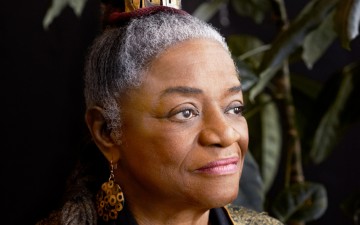
Faith Ringgold

Faith Ringgold

I’m pretty sure she is one of the coolest textile artists around. I first saw her work on the classic, and sadly no-more, children’s television programme Reading Rainbow. They had a great segment where someone would come and read a story to you, and the pages would turn like you were looking at a real book, and the camera would pan across the page as the narrative progressed.

But you don't have to take my word for it.

But you don’t have to take my word for it.

Well, one day, the book on offer was Ringgold’s brilliant Tar Beach . The book details the story of a young girl who imagines herself flying over her city at night as she lies on Tar Beach: the roof of her apartment building. The illustrations came from Ringgold’s quilt of the same name. I was transfixed.

Fast forward several years, and I was writing a paper about her for a second-year Women in Art class at university. I got to know some of her other works, besides Tar Beach. Let me share what I learned with you.

Ringgold was born in 1930 in Harlem, New York City. Her mother worked as a seamstress and fashion designer, so Ringgold grew up around fabric. She received her Bachelor’s degree from the City College of New York. For several years afterwards, she taught in the New York Public School system. She eventually returned to school, and earned her Master’s degree from City College in 1959.

Ringgold started out life as a painter. In the 1960s, she adopted a style of flattened, figural compositions, but her work was rejected by many critics because it bore little resemblance to popular styles and motifs from that time. In the 1970’s, she worked in sculpture, focusing on depictions of historical and contemporary women of colour. It wasn’t until the 1980’s that Ringgold began to work on fabric. She developed a practice of making painted story quilts, which seem to incorporate her education in painting with her familial background in fabrics. It’s these story quilts I want to focus on.

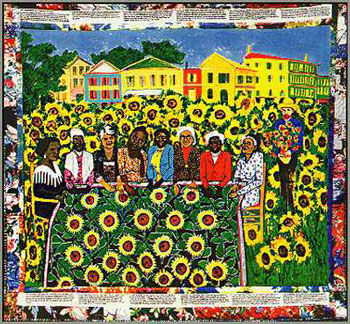
Quilting Bee at Arles. 1991. Private Collection

Quilting Bee at Arles. 1991. Private Collection

A quilt called Quilting Bee at Arles shows a group of figures standing around a finished quilt, which features a sunflower motif, while actual sunflowers grow behind them. A lone figures stands apart from the group. The quilting group is made up of black women of different ages. Their voices can be heard in the written narrative that circles the quilt. Ringgold writes out the words the speak on the border of the quilt. These words give us information about what is going on in this image. The women assert that through their quilting work, they are going to make the world run right again. These women are named: among them stand, left to right, Madam Walker, Sojourner Truth, Ida Wells, Fannie Lou Hammer, Harriet Tubman, Rosa Parks, Mary McLeod Bethune, and Ella Baker. They are joined by a character developed by Ringgold, Willia Marie Simone, who some have argued stands for Ringgold herself. The combination of the sunflowers and the title, which tells us that this is taking place at Arles, gives us clues about who the lone figure might be. He is Vincent van Gogh, well-known Dutch painter, whose still-lifes of sunflowers are among his most acclaimed works. I think this work is Ringgold’s clever and subtle way of suggesting that perhaps it is time for women of colour to be the focus of art and art production: white men have had plenty of time in the spotlight. It is also possible that she means to indicate that the work of women of colour has the power to make positive changes in the world.It also positions women of colour and textile artists as equal to more well-known male artists, like van Gogh. On it’s surface, it’s a bright and cheerful quilt about quilting. Look harder, though, and this quilt seems to demand that we pay more attention to artists of colour, and the stories they want to tell.

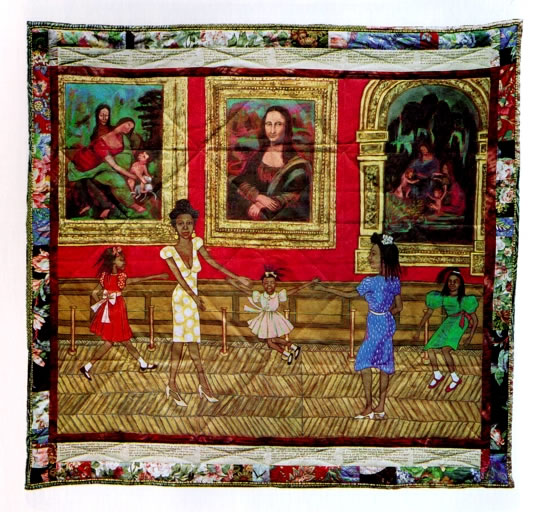
Dancing at the Louvre. 1991. Private collection.

Dancing at the Louvre. 1991. Private collection.

Another fascinating example is Ringgold’s Dancing at the Louvre. Ringgold travelled to Europe as part of her art training, and this quilt might be inspired by her experiences in Paris. This quilt shows us several figures engaged in a lively dance before three famous paintings in the Louvre’s collection: most notable among them is La Giaconde, or the Mona Lisa. (The other two works are also paintings by Leonardo da Vinci.) Here we meet Willia Marie Simone again: she is the dancing woman in the yellow and white dress. In this image, I think we can see Ringgold actively re-writing a historical narritive. Here, she combines traditions of African dance and American quilting with European art collections. Arguably, the performance by Simone, her children, and her friend, is as much a work of art as any of the three paintings on the wall.

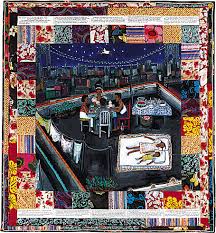
Tar Beach. 1988. Guggenheim Museum.

Tar Beach. 1988. Guggenheim Museum.

The final work I want to look at with you, Reader, is her Tar Beach, the very same quilt I first saw years ago on Reading Rainbow. This quilt features a central image, surrounded by quilted squares of fabric and two horizontal bands of text, which tell the story of young Cassie, and her adventures in flying from Tar Beach over her city each night. Cassie is depicted twice: once on the mattress, star-gazing with her younger brother, and again in the sky, flying over the lights of a distant bridge. We can read this image more than one way. We might see this as a depiction of Cassie dreaming: we are seeing her as she sees herself: flying over her home. It might also be a kind of two-part narrative. The first part of the story shows us Cassie on Tar Beach. The second ‘act’ of the story has Cassie flying. A third reading might be that Cassie is in both places at once: her physical self is lying on Tar Beach with her family, but her spiritual self is free to fly among the stars. This reading aligns itself with some African traditions of dualism: that is, the soul and the body are made of different substances, and can act independently of one another.The presence of the bridge in the background also suggests that we might read this image as an expression of Cassie’s growth into womanhood. She is at once a child and a woman, earth-bound and heavenly, seeing the lights of the bridge before her like beads on a necklace that she wants to wear. Again, we see Ringgold combining different aspects of her art training and background to develop a visually fascinating, but also ambiguous, narrative.

I was lucky enough to meet Ringgold about two years ago. I was very nervous: I felt as though I was in a room with a giant. She was very kind to me. She had on the coolest pair of red leather cowboy boots I have ever seen. She is a great story-teller, and answered questions in a no-nonsense, straightforward way. Luckily for us, Ringgold writes her stories as well as quilting them. She has a remarkable body of written work, which includes memoirs as well as children’s literature. I recommend starting with Tar Beach.(Find it here) The illustrations and the words are soaring and wonderful. And who among us, Reader, has never dreamed of flying?

Yours

Cotton Jenny