Dear Reader;
I have a confession.
I was going to wait to write this post, to let the cat out of the bag, but I just can’t wait a second longer. Here goes.
I love Anni Albers. There. I said it. (Sigh.)
If you haven’t been introduced to Anni, allow me the pleasure: Anni, Reader; Reader, Anni. Isn’t she darling? Now we know everybody.
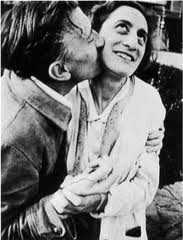
But seriously, if you’re new to Albers, there is no better time to join the fan-club. We meet right now.
Anni Albers was a German/American textile designer, author, jeweller, print-maker, and all-around awesome-pants. She was born in Berlin in 1899, and joined the Bauhaus School in 1922 as a young lady hell-bent on working in architecture or glass. Unfortunately for Anni, the 1920’s might have been many things, but they were not well-known for their stellar gender politics. Anni was re-directed to the weaving workshop, because it was considered appropriate work for women. A young lady like Anni could not handle, according to the teachers and administration at the Bauhaus, the challenges of working in architecture, or with glass. So off to the weaving workshop went Anni, thinking that weaving was “sissy”.
I’ll give you a few minutes to calm down, Reader. I know I’m fuming just thinking about the sillies at the Bauhaus who thought architecture was too hard for Anni. But I promise, the story gets better. Misogyny doesn’t win this time!
After a while, and with encouragement from her director, another super-cool Frau called Gunta Stölzl (“Shhtuhl-zull”), Anni started to dig weaving, and began to experiment with new materials and techniques. She developed a preference for double, triple, and quadruple weaves on a Jacquard loom. She used Cellophane, metallic thread, new industrial fibres, and mixed them with natural fibres like jute, hemp, linen, and cotton (which have been used for centuries) to create sound-absorbing, light-reflecting materials for industry and for interior design. I’ll repeat that: sound-absorbing. Light-reflecting. It boggles the mind.
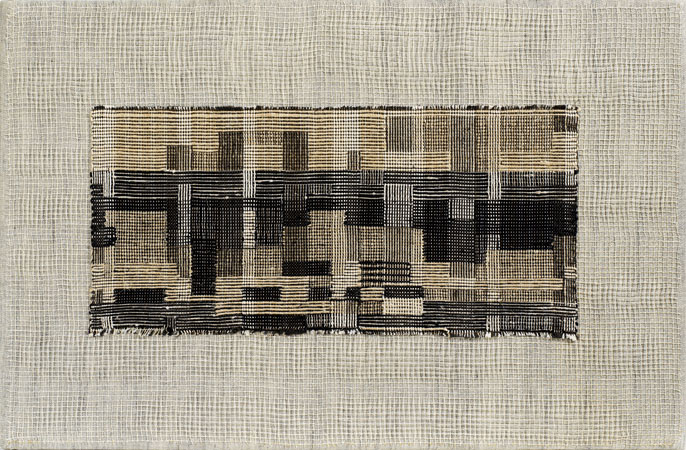
CIty, 1949. From the Albers Foundation
Well, Anni didn’t stop there. She also made jewelry out of bobby pins and washers and vegetable strainers,(!) and she was a great print-maker. Her prints were used by industrial companies like Knoll on their interior fabrics and upholstery. Anni was also a prolific author. She wrote two amazing books (On Weaving and On Designing, which I cannot recommend highly enough.) She also wrote articles for newspapers and journals which promoted the work she and her colleagues were doing at the Bauhaus.

Necklace, ca. 1940. Albers Foundation
In 1933, the National Socialist party (aka Nazis) decided that the Bauhaus was a degenerate school of art, and closed it down. Anni and her husband Josef, along with most of their colleagues, fled Germany. Anni and Josef ended up in America: first in South Carolina, and eventually in Connecticut.
Once in America, both she and Josef taught and lectured. She continued to design fabric for industry, and with her colleagues like Walter Gropius (who was the director at the Bauhaus when Anni joined in 1922.) She traveled to Mexico several times, and was inspired by weaving practices she saw there.
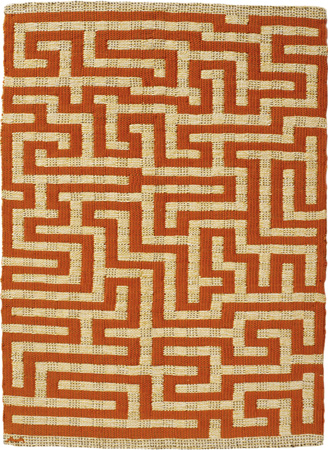
Red Meander. 1954. Albers Foundation
Anni worked tirelessly in several media until her death in 1994, in Orange, CT. Her textiles, and her writings about them, have gone on to influence fibre artists and textiles designers. She worked to marry ancient techniques and materials with modern, man-made fibres and tools to create distinct, functional and fascinating pieces.

Anni Albers designing in her Orange CT home. Albers Foundation.
Long story short: Anni is the coolest. Spread the news!
“But I want to know more about this fabulous lady and all her glorious work!”, I hear you cry. Well, dear Reader, look no further. I am here for you.
The Albers’ Foundation was started by the Albers (Josef and Anni). They have an amazing collection, most of which is available online, along with great articles and photographs. For more Anni and Josef goodness, check out the Albers’ Foundation website.
You can also check out her books On Weaving, and On Designing, which I will never get tired of recommending, and which are also both available on Amazon, and in preview on Google Books, and possibly at your local library.
Want to get your Anni fix in person? The Metropolitan Museum of Art and the Museum of Modern Art have considerable collections of Anni’s pieces for the next time you are in the Big Apple, and want some Anni Albers goodness to soothe your textile-hungry soul. The Bauhaus-Archiv in Berlin also has a few of her larger pieces, and also some of the weaving done by her colleagues from the weaving workshop. Take a look!
Well, Reader, that concludes our introduction to Anni. I’m looking forward to seeing you all at the next Anni Albers Appreciation Night (Every night. Every night is Anni Albers Appreciation Night. Be there or be square.)
Yours,
Cotton Jenny
 cottonjennyfabrics