Hello again, Reader.
I was chatting with friends yesterday about moving. Both buddies are in transit, we were talking about the trials and tribulations of moving. One of my friends was also trying to come up with ways to increase her access to privacy: she’s moving in with several other roommates, and as a dyed-in-the-wool introvert, she’s a little nervous about keeping things happy and happening in the house.

An introvert in her natural habitat.
I totally understood where she was coming from. I live in an apartment, which, most days, is excellent. Every once in a while,though, I want more privacy than my 1970’s, open plan place will afford. And for people like her, and like me, putting in new walls or re-configuring the layout are simply not options. Even if we could afford it (a big old no), most landlords and superintendents don’t much care for their tenants going all DIY.
Besides, permanent walls are so, well, permanent. There has to be a better solution.
Well, Reader, I am here to tell you that there is, and that it comes to us from the wonderful world of modernist interior design. What’s the answer? Fabric!
Seriously though. People have been tackling this problem for a long time, but it’s almost as though we’ve forgotten about their genius solutions. People like Frank Lloyd Wright, Walter Gropius, and Adolf Loos, all of them famous architects, knew that a well-placed curtain worked wonders on a room.

The living and dining room from Walter Gropius’ house in Lincoln, MA. Note the curtains which can be pulled closed or open, depending on which of the two spaces was in use.
But this isn’t going to be a history lesson, Reader. Instead, let’s take a look at how to translate some of the ideas these people came up with, and how we can use them in our own spaces and places.
Most of us have fabrics throughout our homes already. Think about the carpet on your floor, upholstery on your furniture, the mat in your bathroom, the blankets on your bed, the cloth on your table, the curtains at your window. There are, of course, the smaller, more mobile fabrics in our lives, like dishtowels, and place-mats, for example. So really, it’s not all that strange to think about having fabric fulfill just one more job in our homes. And it doesn’t even expect a pay rise.
When it comes to using fabric in this new way, we actually have a couple of options that vary in permanence, which is great news. It means we have choice in how adjustable we want our interior fabrics to be. Curtains of all kinds can be installed along a runner, curtain rod, or in an open doorway without too much difficulty, especially if you use a simple tension rod system, instead of a more traditional bracket and rod or runner bar system. If you’re a handy sort of person, though, installing brackets and rods is pretty straight forward.

Sheer curtains on a runner give this bedroom a dreamy feel while maintaining some privacy.
We also have the option of securing curtains at their other end, making them more permanent and less mobile, if that’s what we are going for. This option lets us get super crafty if we are so inclined: all kinds of fun and fancy materials can be used to achieve a variety of results. Hemp rope threaded through a beam is a more involved project, but looks rustic and striking. Weighting curtains, but leaving them unattached at the bottom, is another great option, which takes a little less know-how, and lets you choose which fabric you want to spruce up that dead space between the living and dining area.

Hemp rope threaded and knotted through a wooden beam, or stretched in a frame, can divide a room while still letting light through.
As with any kind of curtain at a window, we’ve got all kinds of choices when it comes to pattern,transparency, texture, weight, and colour. Light and lacy curtains add delicate sweetness to a bedroom. Heavy, velvet curtains in a dark, solid colour or brocade pattern lend sophistication to a dining room or study, but would certainly overwhelm an airy, cheerful space. Just as with window curtains, taking cues from the fabrics already in your space can help you decide which fabrics will work well. If you’re going for subtlety, panels in a shade similar or identical to that of your walls is a good option. Looking to make a statement? A bold print or eye-catching hue should do the trick. If you are keen, a trip to your local fabric store and a little time at a sewing machine can produce wonderful and unique panels which you can customise to fit your space. If sewing isn’t your thing, buying curtains is an easy alternative. If you are handy, re-purposed fabric stretched and affixed over a frame can be a fun project and results in a mobile screen you can use wherever you please. Basically, the options are numerous and varied, and depend only on how much money, effort, time and skill you want to expend on the process. As a good friend of mine says, you do you.
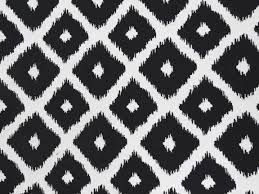
A bold geometric print, used judiciously, adds weight and an edgy aesthetic to a room.
Speaking of mobile screens, these are another great option for dividing up a room to make it multi-purpose, or to get a little more privacy in your life. Folding screens are available at all kinds of furniture and interior design stores, and range from inexpensive to pricey, depending on your preference. They also range in size, colour, and material: you can find very tall ones that will divide an entire space, or shorter, smaller options which can work like blinders to keep you focused at your desk. If you need to tidy in a pinch, tossing all your flotsam and jetsam behind a folding screen is fast and effective, and makes you look like you have your life together, whether you do or not. They are also great because they are mobile and fold easily, making them a cinch to store if you change your mind about where you want them, or want to open up a space for an evening fête, for example. They also work wonderfully well as make-shift dressing rooms and wardrobes. You can hang clothes on them, and dress behind them, the way Disney princesses do. Who doesn’t want a little more fancy in their lives? (You have to provide your own bird attendants. Most furniture doesn’t come with singing animal companions. Shame.)

I woke up like this.
The point of all of this, Reader, is two-fold. Firstly, we have a lot more control over our spaces than we sometimes realise. We have choices. And secondly, fabrics are a lot more flexible, both literally and figuratively, than we often give them credit for. They can separate rooms while still allowing for change, for mobility, for alteration and interaction. Your spaces can be whatever you want them to be. You do you.
Till next time, Reader.
Yours,
Cotton Jenny.
 cottonjennyfabrics