Hello Reader.
Yesterday, someone called me Jessica. It’s happened to me before: actually, it happens all the time. It doesn’t bother me, but it does make me laugh, and confuses me a little. My name isn’t Jessica; it doesn’t sound like Jessica at all; and I don’t think I look remotely like a Jessica.
But it got me thinking about misnomers. And, in my world, one of the biggest victims of shoddy PR is the Bayeux Tapestry.
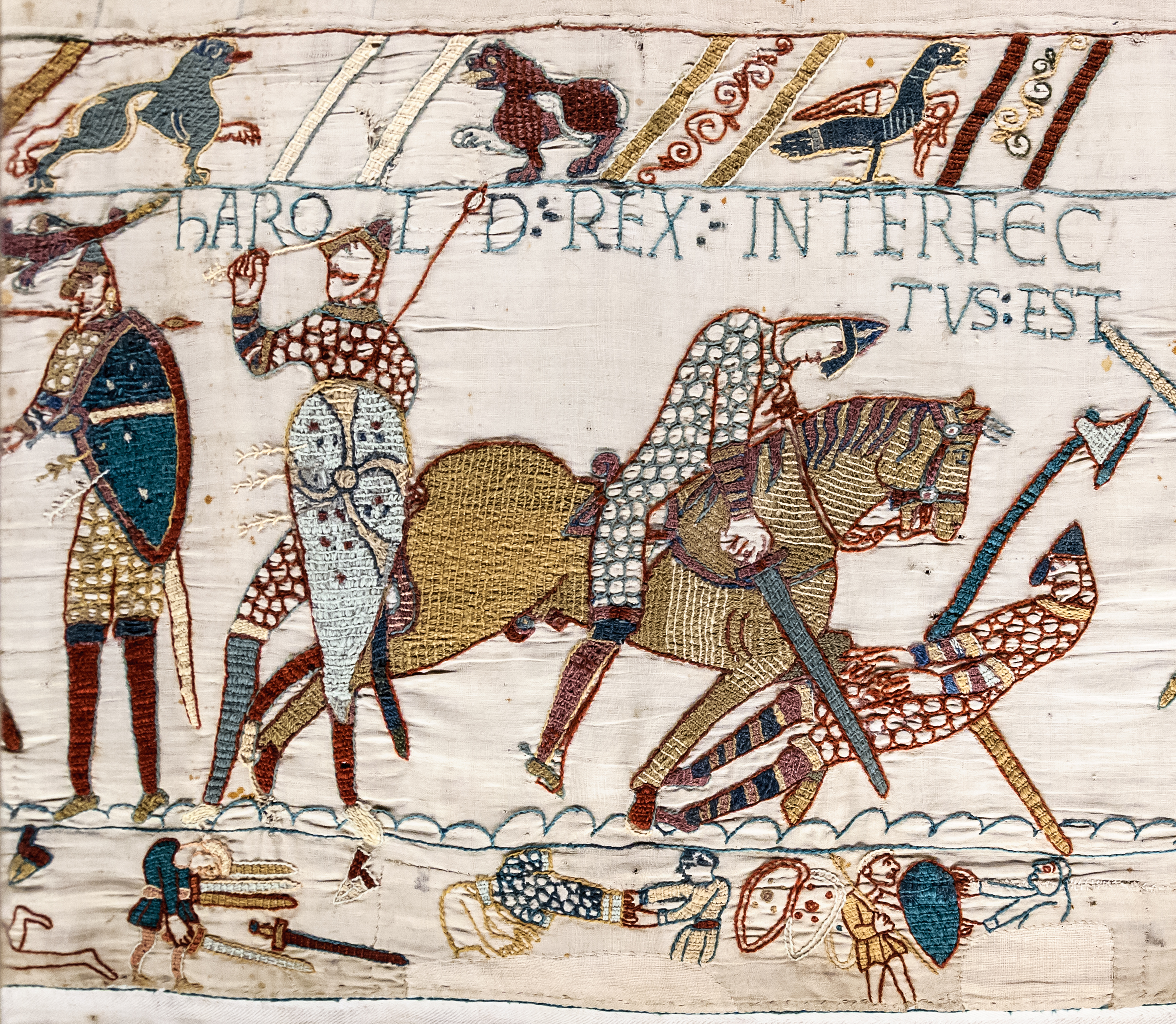
Bayeux Tapestry, Scene 57: Harold’s Death, aka King Harold gets an arrow in the eye. No thank you.
The Bayeux Tapestry details the Norman invasion and conquest of England in 1066. William the Conquerer, the duke of Normandy in France, basically had a big old dust-up with King Harold of England, and, well, William won. Hence the moniker. The Bayeux Tapestry shows us important moments leading up to, and including, the battle. It’s fifty centimetres high and nearly seventy metres long, but it used to be longer: a few sections no longer survive. It essentially works a bit like a comic book or a photograph in a newspaper. There are images of scenes from the battle, and other relevant illustrations, which are captioned with short descriptions in Latin, called tituli, above. It’s really old, has survived miraculously well, illustrates an important moment in European history, and is thus pretty well-known. And that’s the Bayeux Tapestry in a nutshell.
Except it’s not. Firstly, it’s not a tapestry. It’s embroidered woolen thread on tabby linen panels, which were stitched together. And while it resides in the French town of Bayeux now, it isn’t from Bayeux. Actually, scholars aren’t one hundred percent sure where it’s from. Some claim England; specifically the Kent region. Others argue for Burgundy in France.
(Also, I spent a lot of my life saying “Bay-oh”, but that’s not correct. It’s “Bay-yuh.” My mistake.)
The more digging you do, the more mysterious this embroidery becomes. No one’s really sure who commissioned it. Was it Bishop Odo, the newly crowned King William’s half-brother? Was it Queen Matilda, William’s wife? The arguments for Bishop Odo are the most compelling, but others champion Edith of Wessex. There is, essentially, an entire group of scholars who spend many of their waking hours thinking about, writing about, and arguing about, who made it and where it was made. And now, at least for the length of this post, I get to be one of them.
There are a couple of different key clues that give us information about the embroidery, and where it might come from, and who made it. Primarily, we can look at construction and materials. The plant-based dyes and wool thread, as well as the method of couch-stitching used to fill in the images indicate that it may have been made in England: the kinds of plants used to make the blue woad dye grow in the Kentish region of England.
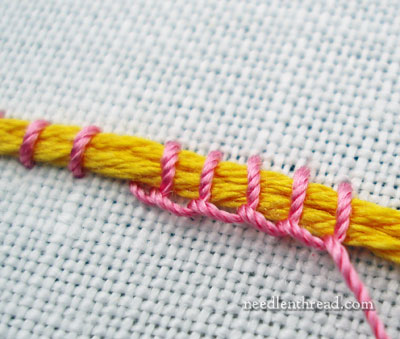
An example of couch stitching.
We can also check out the style of the images. While it is disputed by some, many scholars agree that the Bayeux Tapestry’s style falls within the category of Opus Angilicanum, or Anglo-Saxon needlework. That places us in England again. It might also explain why, despite the fact that this textile depicts a pretty significant Anglo-Saxon defeat, the Anglo-Saxon army and their king, Harold, are depicted in a pretty positive light. The tituli are predominantly in Latin, but there are fragments of Anglo-Saxon, again leading many researchers to believe that this was an Anglo-Saxon work.
This information can indicate who might be responsible for this work. Bishop Odo’s power-base in England was Kent. As a bishop, he also had access to an unpaid labour force: namely, cloistered nuns. Unfortunately, women working without recognition or remuneration is a recurring theme in textile history, and the Bayeux Tapestry may be just another example in a long, long, list. It is also important to note that Bishop Odo’s cathedral and bishopric in France was in… you guessed it… Bayeux. Actually, it was built and dedicated in the 1070’s, which is around the same time that the Bayeux Tapestry was likely finished. That might explain why it ended up there, but we have a huge gap between it’s production after 1066, and the first written record of the textile, which didn’t come until 1476 in an inventory of the cathedral. This gap makes it impossible to know for certain exactly what happened to it.
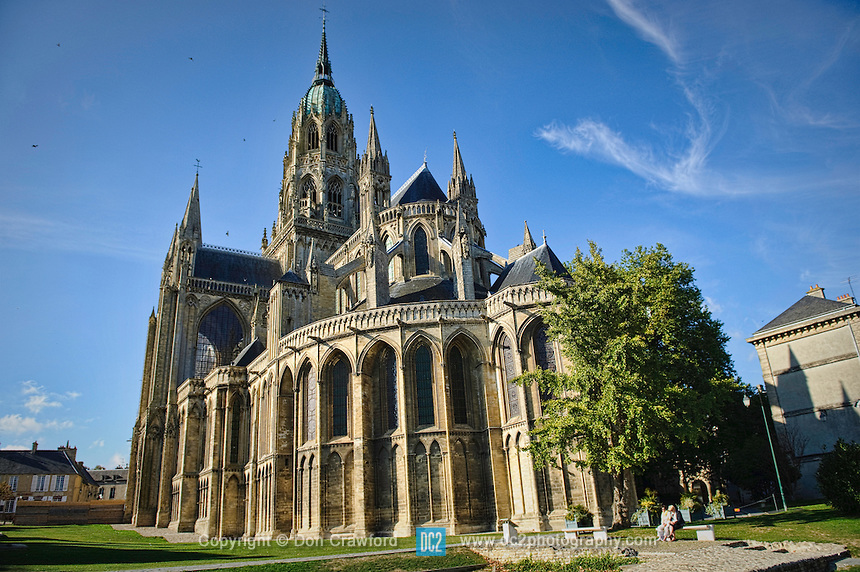
Exterior view Bayeux Cathedral in Bayeux France. Nice digs, Odo.
If the Bayeux Tapestry was commissioned by a Norman bishop, Odo, the half-brother of the conquering Norman king, but actually executed by Anglo-Saxon needle-workers, that might also explain the ‘tone’ of the piece. The Anglo-Saxons aren’t depicted as cowardly, nor as particularly bad people, but there is no doubt about who came out on top: the Normans won, big-time. This leads many scholars to consider the Bayeux Tapestry an example of an apologia. An apologia is a kind of defense of one’s opinions or actions. The Normans, and perhaps especially Bishop Odo, may have felt that they were meant to rule England. It’s possible that they felt they had God on their side. The Anglo-Saxons might have disagreed with them, but the victors usually get to write the history books, (or design the embroidery, as it were). Perhaps the Bayeux Tapestry is an example of recently conquered Anglo-Saxon nuns trying to get a word in edgewise about how their people weren’t so bad, after all.
One way or the other, this tapestry often leaves us with more questions than answers. And unless new information comes to light, which is always an exciting possibility, we’ll have to content ourselves with guessing. I have to say, as frustrating as all these uncertainties can be, there’s also something kind of fun and invigorating about not really knowing. There’s nothing like a good mystery to get your curiosity piqued.

Keen to learn more? Check out A Needle in the Right Hand of God: the Norman Conquest of 1066 and the Making and Meaning of the Bayeux Tapestry by Howard Bloch for more details, and lots of full-colour reproductions!
Until next time, Reader.
Yours,
Cotton Jenny
 cottonjennyfabrics