Hello again, Reader.
In my first year of university, I had to take a maths credit course. Everyone warned me away from statistics, and I knew that calculus or algebra and I were not going to get along (thanks to our failed attempts at relationships all throughout grade school). I reluctantly signed up for the least offensive sounding course on offer: Math in Art.
It was taught by a soft-spoken Russian professor, who made jokes about Donald Duck that no one understood, and a very peculiar teaching assistant. He was friendly, but he had a very intense personality, and he wore the felt liners of his winter boots in the class as though they were slippers. You could hear him swish-swish-swishing on the floor as he padded around at the front of the room, teaching us about rotations.
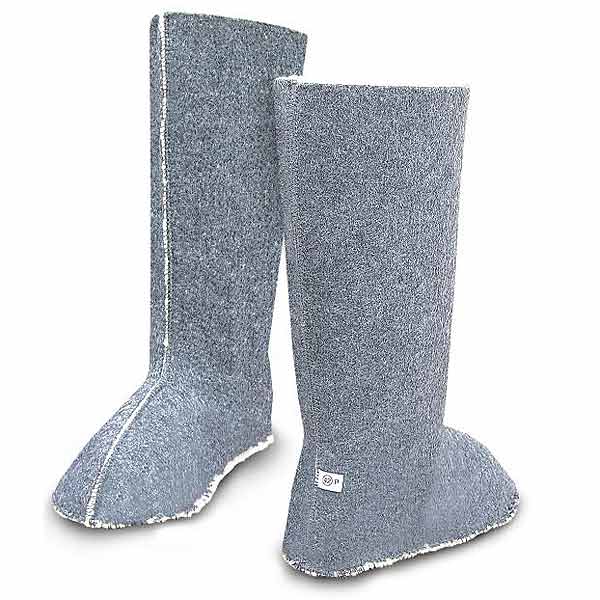
Swish swish swish!
I digress.
It was in this class that I first learned about hyperbolic geometry. Hyperbolic geometry is a kind of non-Euclidean geometry. Euclidean geometry asserts that, in two-dimensional space, for any given line a and point β not on a, there is exactly one line through a that does not intersect b; i.e., that is parallel to b. I don’t really know what that means either, but here’s a picture. Best of luck.
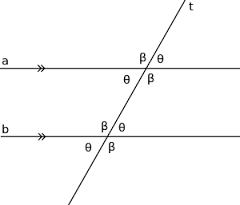
Hyperbolic geometry is non-Euclidean though, so this statement doesn’t apply. In a similar situation,hyperbolic geometry indicates that two distinct lines which pass through a don’t pass through b. Here’s another picture.
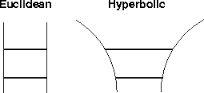
I wish I could comment more intelligently on the maths, reader, but I can’t. I’m sorry.
What I can talk about, however, is crochet.
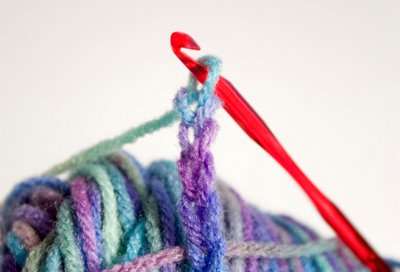
Crochet is a method of producing a fabric by linking together the loops of a single yarn or strand.There are all kinds of different crochet stitches, but they all function on this same basic principle. We usually think about crochet and imagine baby-blankets and afghans on our grannies’ couches.
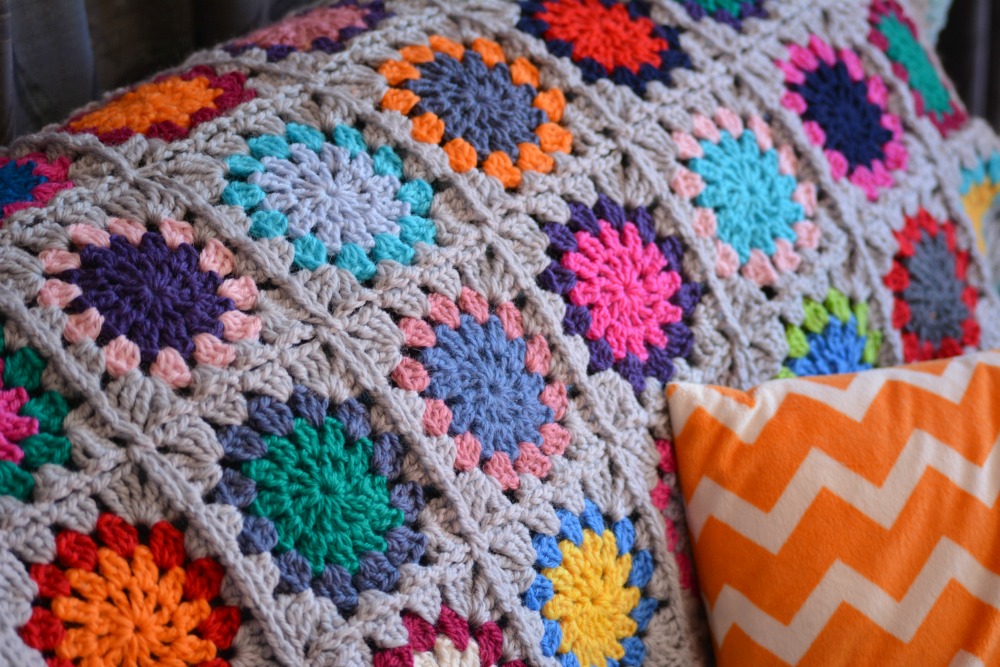
So cozy! So stylish!
Now you might be wondering how hyperbolic geometry and crochet are remotely related. Get excited, Reader: I am here to tell you.
Although hyperbolic geometry was developed and proved in the nineteenth century, it was nearly impossible to actually physically express it until very recently. Mathematicians thought about hyperbolic geometry as an abstract concept, not a physical reality. Even after the advent of computers, describing hyperbolic geometry still proved to be very difficult, which meant that for a long time, it was essentially a theoretical branch of mathematics.
A Latvian professor, Dr. Daina Taimina, first used crochet to express hyperbolic geometry in 1997. She saw her colleagues struggling to make flimsy and inaccurate paper models of hyperbolic planes, and decided to make more durable and accurate examples in wool. (What a smarty-pants.)
This idea was picked up by two Australian sisters, Christine and Margaret Wertheim. Margaret is a physicist, and Christine is an artist. As much as wool and water don’t normally mix well (think about the feeling of wet wool socks, and you’ll know what I mean) they realised that crocheting replicas of coral reefs actually made a lot of sense. The way that a coral grows and develops is in a hyperbolic plane. That frilled, crenulated doughnut shape is nature’s way of expressing hyperbolic geometry: good one, Mother Nature. And Dr.Taimina proved that crochet worked really well to express hyperbolic geometry too. So in 2005, the Wertheim sisters developed an amazing project through the Institute for Figuring in Los Angeles: the Hyperbolic Crochet Coral Reef.
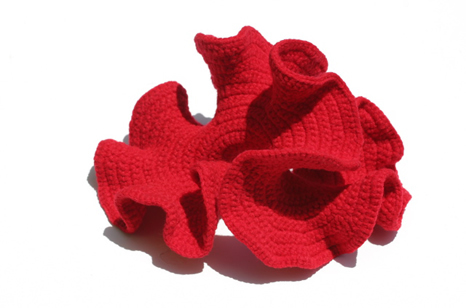
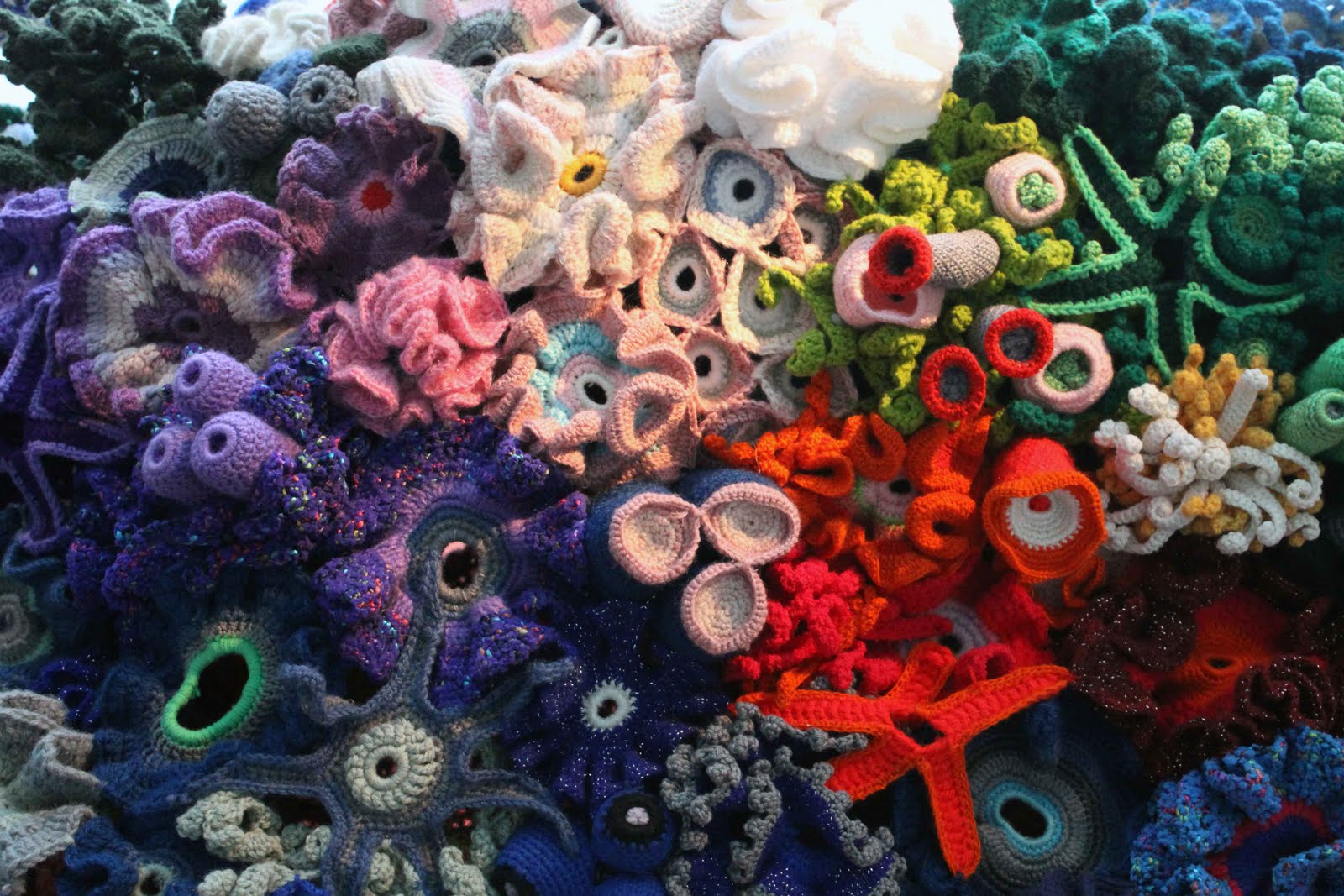
At first, it was just them working on the project. But after a very successful show in 2007 in Chicago, more and more people became involved, and the exhibition project literally grew and grew. Now, approximately ninety-nine percent of the crochet coral is made by women, including the Wertheim sisters, and the exhibition has been shown all over the world.
This project deals with the intersection of mathematics, environmental issues, and crochet. When the project started in 2005, issues of global warming were at the forefront of a lot of scientific discourse. Not only does the Hyperbolic Crochet Coral Reef show its viewers mathematical information, it also explains some of the damaging results of rising sea temperatures, like bleached coral. Many of us don’t have access to a coral reef on a daily basis, but this exhibition gives us an idea of what this remarkable and environmentally crucial ecosystem is like, and how it is suffering as a result of climate change.
This project also does great stuff for women. Unfortunately, the fields of science and mathematics have been historically dominated by men, and that trend continues today. But things are changing. Projects like Crochet Coral Reef can show viewers both inside and outside the mathematics and science community that women absolutely have a place in these disciplines, and that their contributions, woolen or otherwise, are essential to advancement in the field. And that’s good news for everyone.
Want to learn more about this amazing undertaking? You can see Margaret Wertheim’s TED talk about her project here. The exhibition also has its own website, where you can check out photographs and see when the Crochet Coral Reef is coming to a museum or gallery near you!
So to all you crocheters out there, I say: keep up the good work! What you do is not only an art form, but also an excellent model for an important branch of (once) theoretical mathematics: how fancy! And to those of us who haven’t gotten hooked on hooking: you may never look at Grannie’s old afghan blanket the same way again.
Get hooked!
Until next time, Reader.
Yours,
Cotton Jenny
 cottonjennyfabrics
I think I have a new favourite word.. crenulated. At least it will be added to the always growing list of special descriptive words that i hold near to my heart.
LikeLike
I love it too! So fun!
LikeLike