Hello again, Reader. Hoping this post finds you in good spirits, and yearning for learning!
As always, we begin at the beginning. What is a textile? What is a fabric?
Our trusty friend the dictionary tells us that fabrics are anything man-made, which a pretty broad category. Generally we say fabric and mean man-made, pliable, fibre-based materials which display tensile strength: they can be pulled and stretched and won’t ‘break.’ Textiles are just woven fabrics. Simple, right?
Well, yes and no. We throw these words around a lot, and use them interchangeably. For example: that cotton sundress is made of a (pretty darn cute) textile. The knitted sweater you throw over it, however, is not a textile: its a fabric.
This may seem pedantic, and well, yes, it is. However, knowing about a fabric’s construction can help us make decisions about how to treat it. The startlingly wonderful Anni Albers reminds us that any fabric is mainly the result of two things: its fibres; and its construction. (As an aside, please, please, please check out her two big books On Weaving and On Design, or visit the Albers Foundation website to check out her work and her pretty photographs. Like this one.)
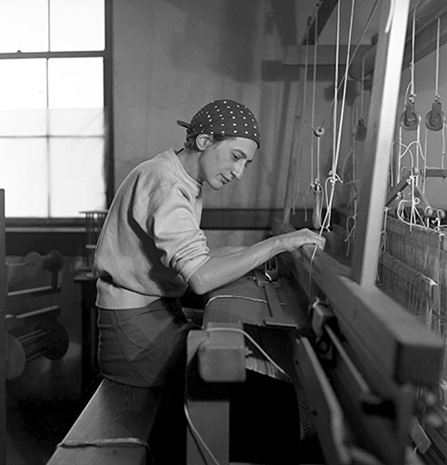
Albers in the weaving workshop at the Bauhaus school in Dessau. Image courtesy of Albers Foundation.
This means that we can have all kinds of variations on the types of fibres available to us. Natural fibres fall into two main categories: plant-based and animal-based. Man-made fibres get their own fancy categories. Ready for a list? I know I am!
| Natural | Man-Made | |
| Plant | Animal | rayon |
| Flax/linen | cashmere | polyester |
| cotton | angora | nylon |
| Sisal | alpaca | spandex |
| Hemp | silk | acrylic |
| Jute | mohair | acetate |
| Bamboo | wool | saran |
Now, this is obviously not an exhaustive list. (For more, check out Bernard P Corbman’s Textiles: Fiber to Fabric 1975) There’s all kinds of sub-categories and other variations on these fibres. And most of us can find fibre blends in the clothes we wear, which means there are even more potential combinations. That’s just one half of the equation. Our darling friend and mentor Anni tells us that the second part is a fabric’s construction. But what exactly does she mean by that?
Well, despite the fact that we don’t often think about fabrics as things that need building, that’s a pretty good metaphor for how fibres come together to make a fabric. All fabrics have a structure, which is developed by how the fibres interact with each other. Technical enough for you yet, Reader? Let’s look at some examples.
A single-weave textile will have stretch on a diagonal (called the bias), but be a bit more rigid if you stretch it top to bottom, or side to side, depending on how tightly it’s woven. That’s because the textile has one set of threads running top to bottom, and another set running side-to-side. These thread sets are interwoven with one another, and kind of ‘lock’ each other into place. This stiffness means we can usually cut a woven textile without ruining it. That fabric of cotton sundress we talked about earlier is probably made this way.
But now let’s consider that little cardigan. It’s knitted. Knitting is a process of linking a series of loops with one another to make a fabric. Because it is based on loops made from one long yarn, rather than straight linear threads, knitting produces fabric which tends to stretch in any direction. (Actually, the single looped yarn also make it possible to express hyperbolic geometry with knitting and crochet…but more on that later!) If you’ve ever ripped or snagged a wool sweater or scarf, you’ll know that cutting a straight-up knitted fabric is a good way to ruin it.
These are pretty obvious examples, but the principle applies to most fabrics. If you know of what the fabric is made, and how it was made, your chances of treating your fabrics properly, and keeping them in good condition, are much higher. And that can only be good news!
The other thing this information can tell us is what the best uses for our fabrics might be. We know that boiled wool is probably not the best for that sunny frock, but a cheerful and innocent-looking cotton batik (“bah-teek”) might also not be a good pick, despite its adorable pattern. That’s because batiks are dyed using a wax-negative process (sort of like Eastern-European Easter eggs), and the dye is applied to the surface of an already-woven cotton.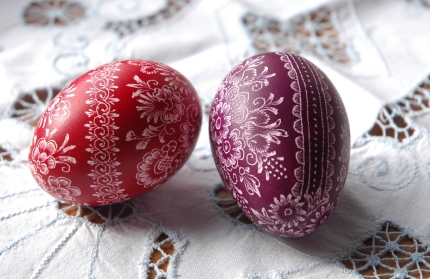
The threads are dyed in the fabric, not ‘in-the-wool.’ (Incidentally, that’s where that saying comes from.) A fabric whose dyes were added to the threads before the fabric was made is more likely to keep its colour and not fade, run, or bleed colour. A batik is dyed after the fabric has been woven, which means that the dye might be more likely to run or fade. This bad news for clothes, especially clothes for warm weather, unless you are keen on dyeing your skin with your pretty new dress. (No, me neither.)
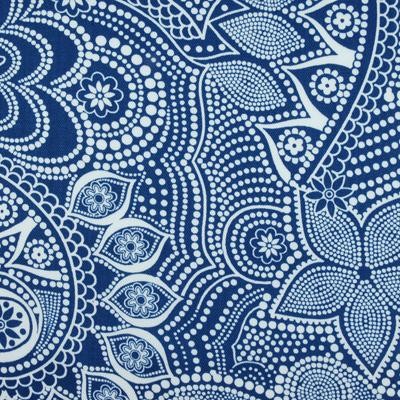
Well, Reader, I’ll be darned if I’m not inspired to frolic through a fabric store, what with all this talk of batiks and cotton sundresses. Until next time, then!
Yours,
Cotton Jenny.
 cottonjennyfabrics