Hello again, Reader.
It’s been a while. I’ve missed you.
Things are settling into a rhythm here, and so I am back at the keyboard, where I belong.
A few days ago, I was sitting in this very spot, working away, and as I crossed my legs, I heard a monstrous shredding sound. The fabric of my black jeans had torn: a gaping maw grinned at me from my upper thigh. My heart sank: a perfectly good pair of pants, ruined.
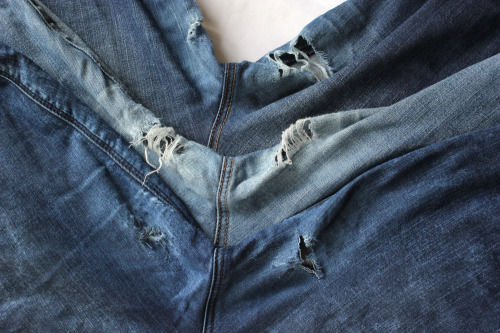
The horror!
This often happens to older and well-worn pants when your thighs meet. The fabric rubs together, and wears down over time, so that eventually a hole develops, or as in my case, blows right through your pants in one fell swoop.
I was frustrated: I didn’t have the budget to buy a brand new pair of pants, and besides, I like these jeans. They are comfy, classic, and easy to dress up or down. I wear them a lot (which explains the hole). I did go out looking for a new pair, half-heartedly, but everything I saw paled in comparison to my wonderful black jeans. I admitted defeat, and put them in the back of my closet, mourning their untimely passing.
But a few nights ago, I came across instructions for darning, and after a little digging, discovered that it is possible to darn denim! I was so excited! Maybe my beloved black jeans weren’t for the bin just yet.
What I found, Reader, is that there seems to be two main ways to repair rips and tears in denim (and other cloth too). The first way is to get a backing fabric, like a stiff but lightweight cotton organdy, and use it as a little bridge between the two sides of the hole. Then you stitch over the fabric to join the two sides, with the backing fabric giving the stitches an anchor. Finally, you trim off the excess backing fabric, and voilá: your jeans are back to working order! This method works best if you have a sewing machine, because you can use the super-strong zig-zag stitch very easily, and the whole process takes little to no time, start-to-finish. You can find a full video of this process here.
I do not have a sewing machine at the moment. So as excellent as this first method is, I am fixing my jeans the old-fashioned way: by hand. This second type of darning is more traditional, and is often associated with mending knitted garments like socks, but it can be used for a number of different purposes. To start, you trim off the excess threads around the tear, so that the edges are clean. Then you sew anchor lines parallel with the tear, starting just above and finishing just below the actual hole. Finally, you weave a threaded needle in and out of your anchor lines (weavers will recognise the anchor lines as warp threads, and the ‘fill’ as weft threads). What you are essentially doing is weaving and sewing at the same time. With every stitch, you are re-building your fabric. As such, it’s often best to use thread in a similar weight and fabric to your original garment. In my case, I have an easy time of things: my jeans are mostly cotton, and so a dense cotton thread, like a darning or embroidery thread, do the trick. I’m also lucky that my jeans are black, because colour matching is a breeze. If you are working on blue-jeans, or a patterned fabric, things can get a little more tricky. You have a couple of choices. Either pick a colour from your pattern, or match a thread as closely as possible to your fabric, to disguise where your hole was, or go for broke and get a contrasting colour to show off your darning skills and brighten up your garment.
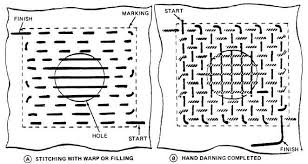
Two steps to darning by hand.
I was thrilled to find out all of this stuff, for a couple of reasons. Firstly, I like the clothes in my closet. Some of them I have had for a very long time, and it would be a shame to toss them on account of a tiny tear. Furthermore, needles and thread are typically a lot less expensive than a brand new pair of jeans, so repairing damaged garments takes the pressure off my pocket-book. Finally, making do and mending means that fewer of my clothes end up in a land-fill, and that can only be a good thing.

Reduce, re-use, recycle…and now, repair!
I mean, even Mary Poppins darns the odd sock. If it’s good enough for Mary, it’s good enough for me.

Mary Poppins means business.
I’ll be sure to post pictures of my progress with my very first darning project, but for now, I’d love to hear from you! What have you mended/darned/fixed/repaired/up-cycled, and how did it go? Any handy hints you’d like to share? Let me know, Reader!
Until next time.
Yours,
Cotton Jenny
 cottonjennyfabrics