Felt Flowers

Hello again, Reader.

Spring is creeping in everywhere, taking winter’s place and putting me in a good mood. So to join in the fun, I thought I’d share these instructions for simple, pretty felt flowers. I like this idea for a number of reasons: it’s dead easy, so it’s great to do with little helpers. The results are pretty and versatile. You can use them to dress up pretty much any surface imaginable. They’d make great additions to spring-time cardigans, festive table-runners, or even bobby-pins and hairbands for the flower child in all of us. They’d also make great bouquets and wreaths, depending on their size.

These bright little blossoms are also great because they are so easy to customise. They can be any size, shape, and colour you like. The plain version that I’ve detailed here look a bit like ranunculi or shrub roses, but depending on how you customise your blooms, they might look completely different. You can dress them up with beads and buttons. You can use pinking shears to make any kind of petal you can think of. The instructions below stick with the basics, but your flowers can look any way you choose.

The final reason I love these pretty petals is that they use up left-over felt. I always seem to have felt flotsam and jetsam floating around in my sewing cubby. Where does it come from? Why is it there? I don’t have the answers to these questions, but happily, with these flowers, it doesn’t really matter. I can use it up instead of leaving it to take up space.

So let’s get growing. Here’s what you’ll need:

  • felt 20160306_130728[1](any colour- I usually try to have two colours for petals and leaves, but that’s up
    to you)
  • scissors/shears
  • needle and cotton thread


Now that you’ve got all your equipment together, here’s how to get started:

Step 1: Using your shears, cut circles of different sizes into the felt you want to use for your petals. In my case, I’m going to save the green felt for leaves, but the red and lilac felt are for petals. If you are making felt flowers with children, you may need to help them with this step: shears are very sharp, and child-safe scissors are often not sharp enough to cut through felt (or any other fabric, for that matter).

20160306_130914[1].jpg

Step 1

Step 2: Cut each felt circle into a spiral, starting from the outside and working your way towards the centre. Once you reach the middle, cut the absolute centre out of your spiral, so that there’s a small hole in the middle. If you want textured petals, now is the time to trim one side of the felt spiral into any repeated shape you like. This side will be the top of your flower. It should look like this:

20160306_130955[1].jpg

Step 2

Step 3: Beginning from the centre of your spiral, roll up the felt strip. It should look a bit like a cinnamon roll. I found it helpful to pinch it gently between my fingers to keep it flat. Keep rolling until you’ve reached the end of your felt strip. Put your little roll of felt down flat.

20160306_131045[1]

Step 3

20160306_131145[1]

Step 4: Leaving your felt roll for a moment (don’t worry, it won’t unravel: felt sticks to itself), thread your needle. Now carefully pick up your little roll like you did when you were rolling it up (that is, pinched between your fingers). Imagining that you are trying to skewer your felt cinnamon bun with your needle, sew from one side of your roll to the other. Be careful not to let the thread show at the top.Your thread should pass through every layer of felt, so that none of your ‘petals’ will come loose. Depending on the size of your felt roll, you may need to do this in a few places,  but for my little flowers, one or two stitches was enough. When you are certain that your roll won’t come un-done, knot your thread on the underside of your flower, and trim any excess thread.If you are making these flowers with children, you’ll likely need to help them with this step.*

20160306_131423[1].jpg

Step 4

Step 5: Customise your flower! You could add felt leaves to the bottom of your blooms. Beads or buttons sewn into the centres could be fun. When you are happy with how your flowers look, you can applique them to cloth, attach them to pipe-cleaner stems to make a bouquet, or onto a wreath for added texture and colour. Let your imagination go a little wild: felt is a very flexible, forgiving fabric, so you have lots of options.


20160306_131537[1].jpg

Step 5: Finished!

*If, dear Reader, the very thought of threading a needle makes your stomach churn and your head ache, never fear! These flowers are just as easy to make using a hot glue gun, or even good-quality fabric glue. Instead of sewing them as described in Step 4, simply put a little dot of glue on each layer as you roll the felt up, and let it dry. You can also use glue to attach any fun stuff (beads, buttons, glitter, leaves, etc). If you are using a hot glue gun, do be careful to avoid burns. Young children should not use glue guns, so if you are making these flowers with your little ones, you’ll need to help them with step.

Have any comments or questions about these instructions? Leave me a comment below! I’d love to hear from you! Bonus points for pictures of your own felt flowers! I hope you’re inspired to get growing some of your own felt flowers, and that these instructions have put a little Spring in your step!

Until next time, Reader.

Yours,

Cotton Jenny
Darn that Denim

Hello again, Reader.

It’s been a while. I’ve missed you.

Things are settling into a rhythm here, and so I am back at the keyboard, where I belong.

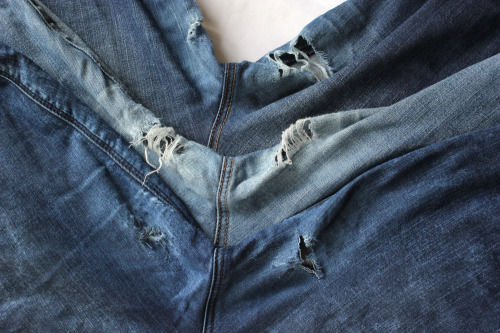
A few days ago, I was sitting in this very spot, working away, and as I crossed my legs, I heard a monstrous shredding sound. The fabric of my black jeans had torn: a gaping maw grinned at me from my upper thigh. My heart sank: a perfectly good pair of pants, ruined.

The horror!

The horror!

This often happens to older and well-worn pants when your thighs meet. The fabric rubs together, and wears down over time, so that eventually a hole develops, or as in my case, blows right through your pants in one fell swoop.

I was frustrated: I didn’t have the budget to buy a brand new pair of pants, and besides, I like these jeans. They are comfy, classic, and easy to dress up or down. I wear them a lot (which explains the hole). I did go out looking for a new pair, half-heartedly, but everything I saw paled in comparison to my wonderful black jeans. I admitted defeat, and put them in the back of my closet, mourning their untimely passing.

But a few nights ago, I came across instructions for darning, and after a little digging, discovered that it is possible to darn denim! I was so excited! Maybe my beloved black jeans weren’t for the bin just yet.

What I found, Reader, is that there seems to be two main ways to repair rips and tears in denim (and other cloth too). The first way is to get a backing fabric, like a stiff but lightweight cotton organdy, and use it as a little bridge between the two sides of the hole. Then you stitch over the fabric to join the two sides, with the backing fabric giving the stitches an anchor. Finally, you trim off the excess backing fabric, and voilá: your jeans are back to working order! This method works best if you have a sewing machine, because you can use the super-strong zig-zag stitch very easily, and the whole process takes little to no time, start-to-finish. You can find a full video of this process here.

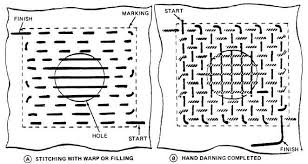
I do not have a sewing machine at the moment. So as excellent as this first method is, I am fixing my jeans the old-fashioned way: by hand. This second type of darning is more traditional, and is often associated with mending knitted garments like socks, but it can be used for a number of different purposes. To start, you trim off the excess threads around the tear, so that the edges are clean. Then you sew anchor lines parallel with the tear, starting just above and finishing just below the actual hole. Finally, you weave a threaded needle in and out of your anchor lines (weavers will recognise the anchor lines as warp threads, and the ‘fill’ as weft threads). What you are essentially doing is weaving and sewing at the same time. With every stitch, you are re-building your fabric. As such, it’s often best to use thread in a similar weight and fabric to your original garment. In my case, I have an easy time of things: my jeans are mostly cotton, and so a dense cotton thread, like a darning or embroidery thread, do the trick. I’m also lucky that my jeans are black, because colour matching is a breeze. If you are working on blue-jeans, or a patterned fabric, things can get a little more tricky. You have a couple of choices. Either pick a colour from your pattern, or match a thread as closely as possible to your fabric, to disguise where your hole was, or go for broke and get a contrasting colour to show off your darning skills and brighten up your garment.

Two steps to darning by hand.

Two steps to darning by hand.

I was thrilled to find out all of this stuff, for a couple of reasons. Firstly, I like the clothes in my closet. Some of them I have had for a very long time, and it would be a shame to toss them on account of a tiny tear. Furthermore, needles and thread are typically a lot less expensive than a brand new pair of jeans, so repairing damaged garments takes the pressure off my pocket-book. Finally, making do and mending means that fewer of my clothes end up in a land-fill, and that can only be a good thing.

Reduce, re-use, recycle...and now, repair!

Reduce, re-use, recycle…and now, repair!

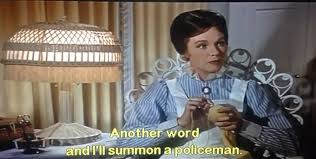
I mean, even Mary Poppins darns the odd sock. If it’s good enough for Mary, it’s good enough for me.

Mary Poppins means business.

Mary Poppins means business.

I’ll be sure to post pictures of my progress with my very first darning project, but for now, I’d love to hear from you! What have you mended/darned/fixed/repaired/up-cycled, and how did it go? Any handy hints you’d like to share? Let me know, Reader!

Until next time.

Yours,

Cotton Jenny

Doily Dear

Hello again, Reader.

In my hall closet is a box of odds and sods. It’s mostly fabric scraps, but there is also a collection of doilies from my grandmother’s house, which made their way to me a few years ago. They’ve been sitting in my closet for quite a while now, and recently, I was inspired to do something with them. So I fired up the old Google, and hunted for interesting ideas.

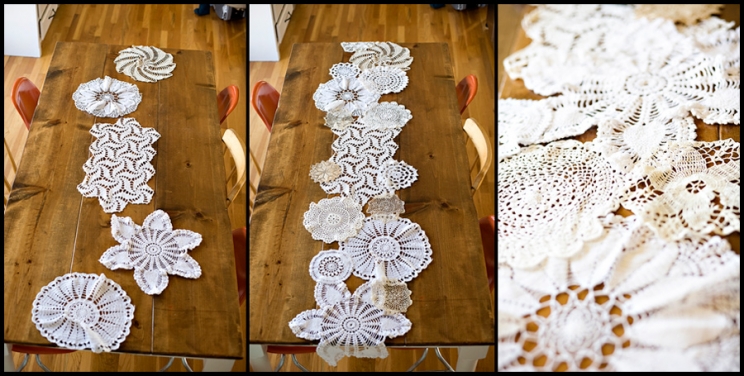
Doily table runner

Doily table runner

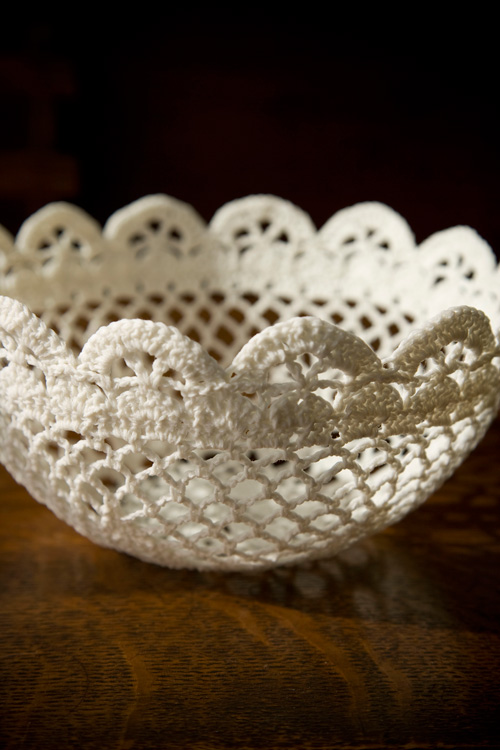
I found some pretty nifty notions, but there were three I liked the look of best. The first is a table runner made of crocheted doilies (just like the ones in my closet) sewn together. The second is a bowl made from a stiffened doily. The versions I saw indicated that you should harden it with glue or Mod Podge, but the image of the finished product reminded me of the lace bowls my god-mother places around her house on Christmas Eve. She soaks hers in water and cornstarch, and then fits them over a jar or bowl, and when they dry, they stand up on their own. The nice thing about doing it this way is that you can wash the starch out of the lace, at which point you can store it flat to be brought out again the next time you want to use it.

Lace bowl

Lace bowl

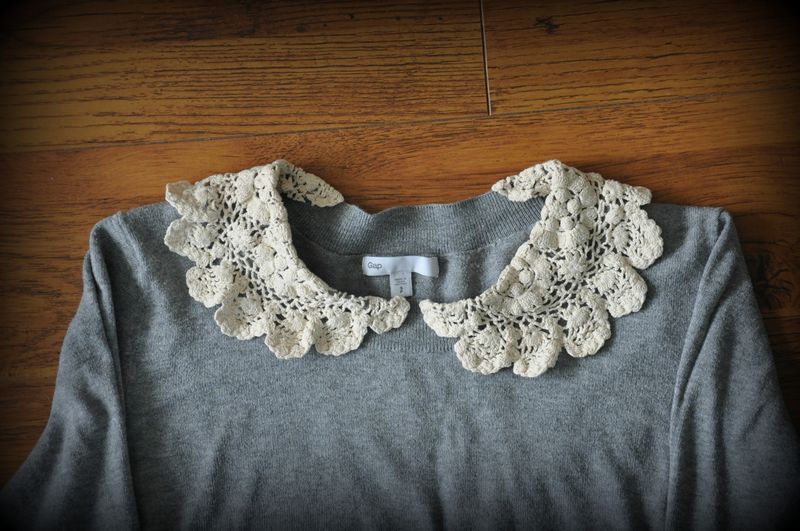
The third one I dug was perhaps a little more involved, but very pretty. A large-enough doily would make a delicate and dainty collar on a blouse or sweater. You could alter it to make it a peter-pan collar, or just leave it as-is for a simpler version. I love this idea. All these projects made me anxious to get stuck in to my own work!

A cute collar: prim, preppy, and pretty!

A cute collar: prim, preppy, and pretty!

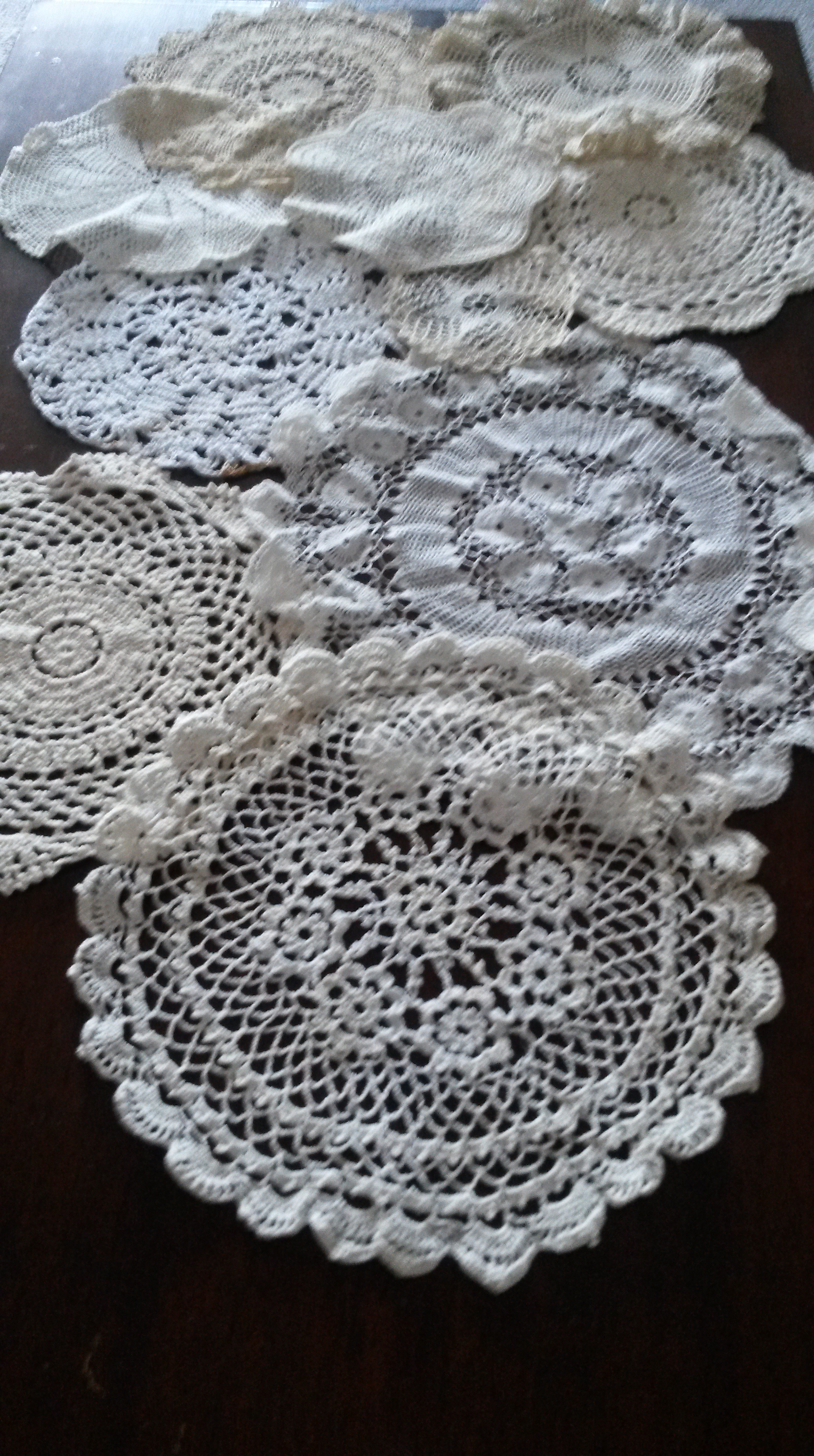
So, out came the doillies, and my needle and thread. Here are the doilies I chose to use: they are all roughly in the same colour palette, and I like that they vary a little bit in size.

Spots of lace: they remind me of snow.

Spots of lace: they remind me of snow.

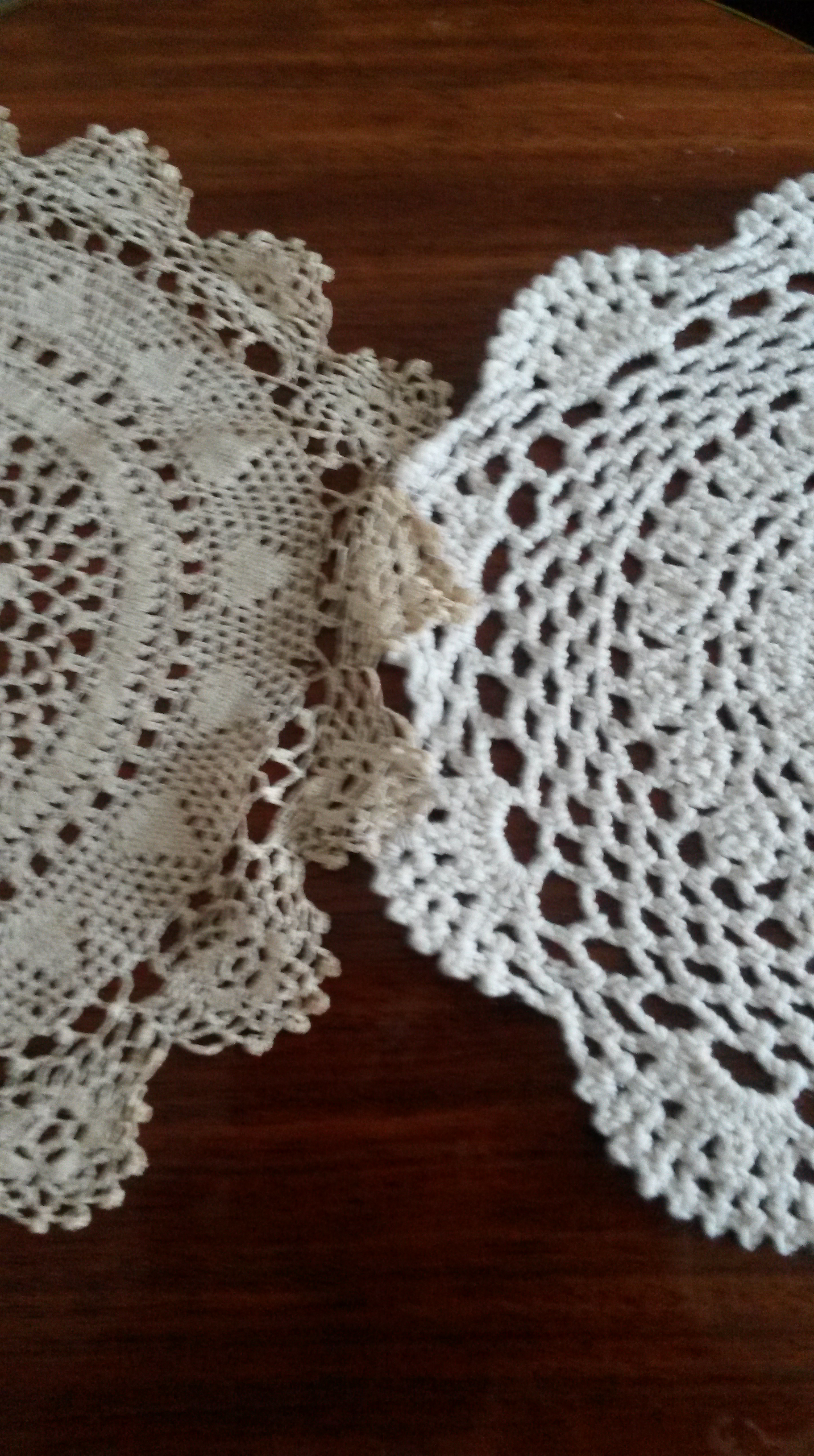
What I ended up doing was laying them out in the order I wanted, and then simply stitching the edges together by hand. I found I liked the look best when I placed the biggest ones down first, like a kind of foundation, and then added the smaller ones on top. It seemed more balanced and visually pleasing to me to do it that way than to simply line them up and hope for the best. I also liked the look of off-setting them, so that they aren’t centred or in a straight line.

Simple tacking joins do the trick here.

Simple tacking joins do the trick here.

Now, it goes without saying that if you wanted to speed up this process, a sewing machine could certainly help. I don’t currently have access to a sewing machine, so hand-sewing it is! The whole job took me about thirty minutes, but most of that was arranging and re-arranging the doilies just so. The actual sewing was over in a flash.

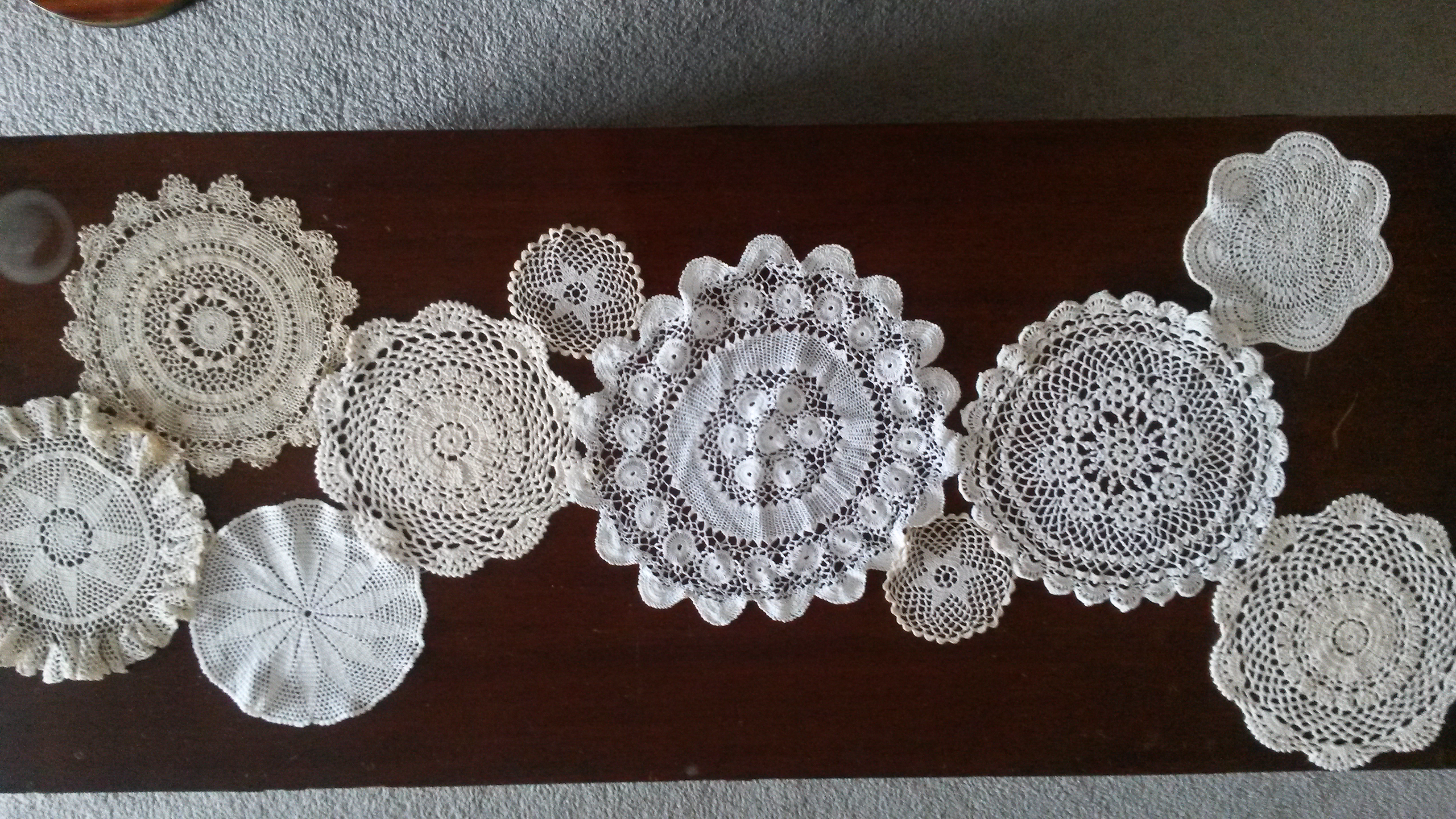
All done! (For now.)

All done! (For now.)

Here’s the finished product. The nice thing about a project like this one is that you can add to it very easily. Actually, removing doilies would be pretty simple too: the stitches are basically just tacking the doilies together, so it would be a cinch to take them out and start again, or just make adjustments. You can add or subtract as many or as few doilies as you wanted to fit the table you’re using. Be warned, though: if you hand-stitch these together, the finished result is going to be fairly delicate. It’s best to machine sew these babies if you plan to put the runner in the wash.

These might make a nice addition to a plain table, and would likely work a treat on a table at a rustic/DIY/country wedding. They’d also be a nifty appliqué, if that’s your thing.

Do you have any favourite doily-inspired projects? I’d love to hear about them: leave me a comment! Bonus points for pictures!

Until next time, Reader.

Yours,

Cotton Jenny
Knit It!

Hello again, Reader.

I’m a big fan of the BBC programme QI, and I recently watched an excellent episode from their K Series called “Knits and Knots.” (Watch it here.) On this episode, Stephen Fry and Alan Davies, along with Ross Noble, Sue Perkins, and David Mitchell, delve into the fascinating world of knitting and knotting, as well as other topics beginning with a silent ‘k’.

Now, I knit quite a lot, but mostly, I knit to relax. There’s something soothing about the repetition, the gentle clickety-clack of the needles, and the memories of my grandmother teaching me to knit as a little girl that makes the whole process very calming for me. As a result, however, my knitted projects tend not to be especially complex or adventurous. But’s that’s more about me than it is about knitting itself. Because knitting can produce some pretty incredible things. “Such as?” I hear you asking, Reader. Well, read on!

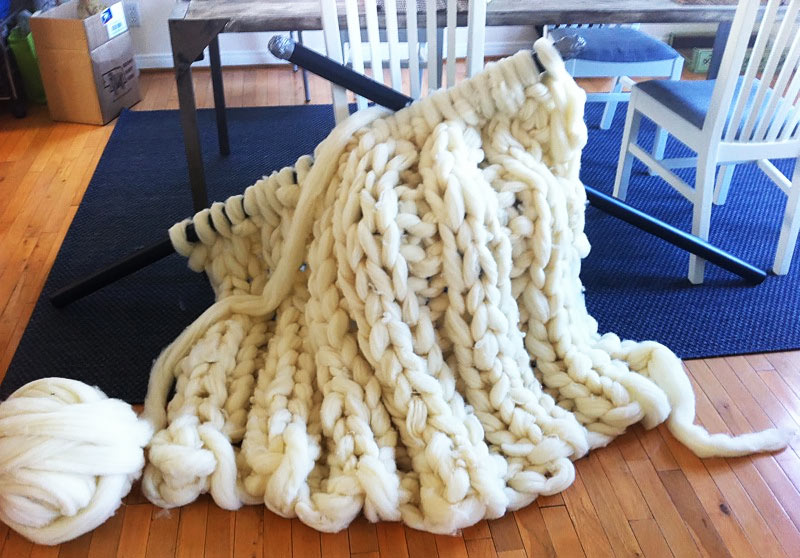
Go big or go home!

Go big or go home!

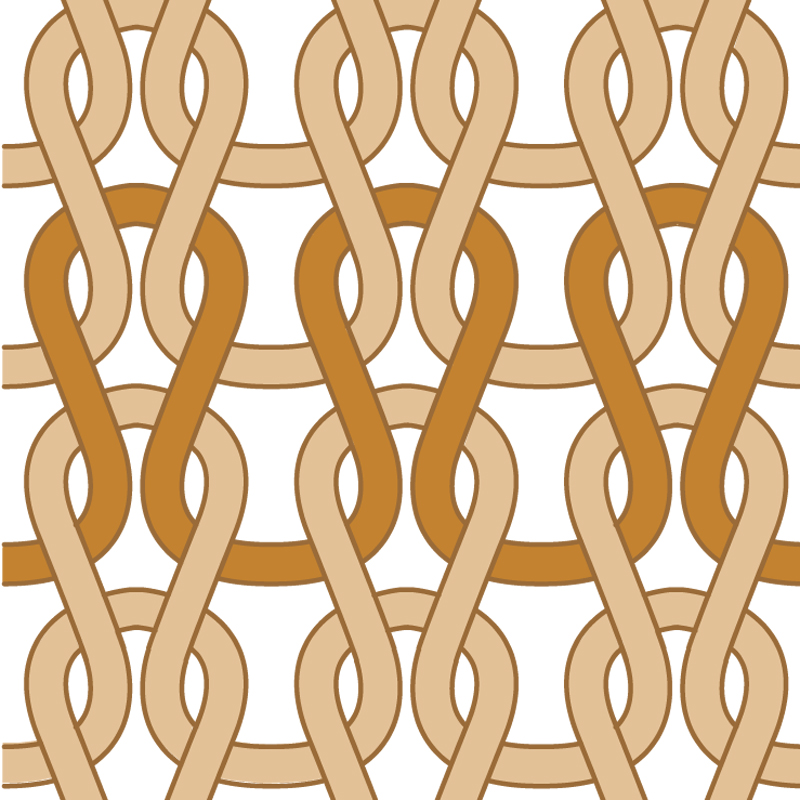
A growing trend in the world of knitting is large-scale projects. Giant needles, arm- and hand-knitting, and enormous yarn results in gargantuan examples of knitted objects. This process often focuses on the texture of the material, because the individual stitches are so large. It also shows off the construction of the knitting piece itself. Knitting, by the way, is a series of inter-twined loops made from a single yarn or strand.

97-know-knits-06

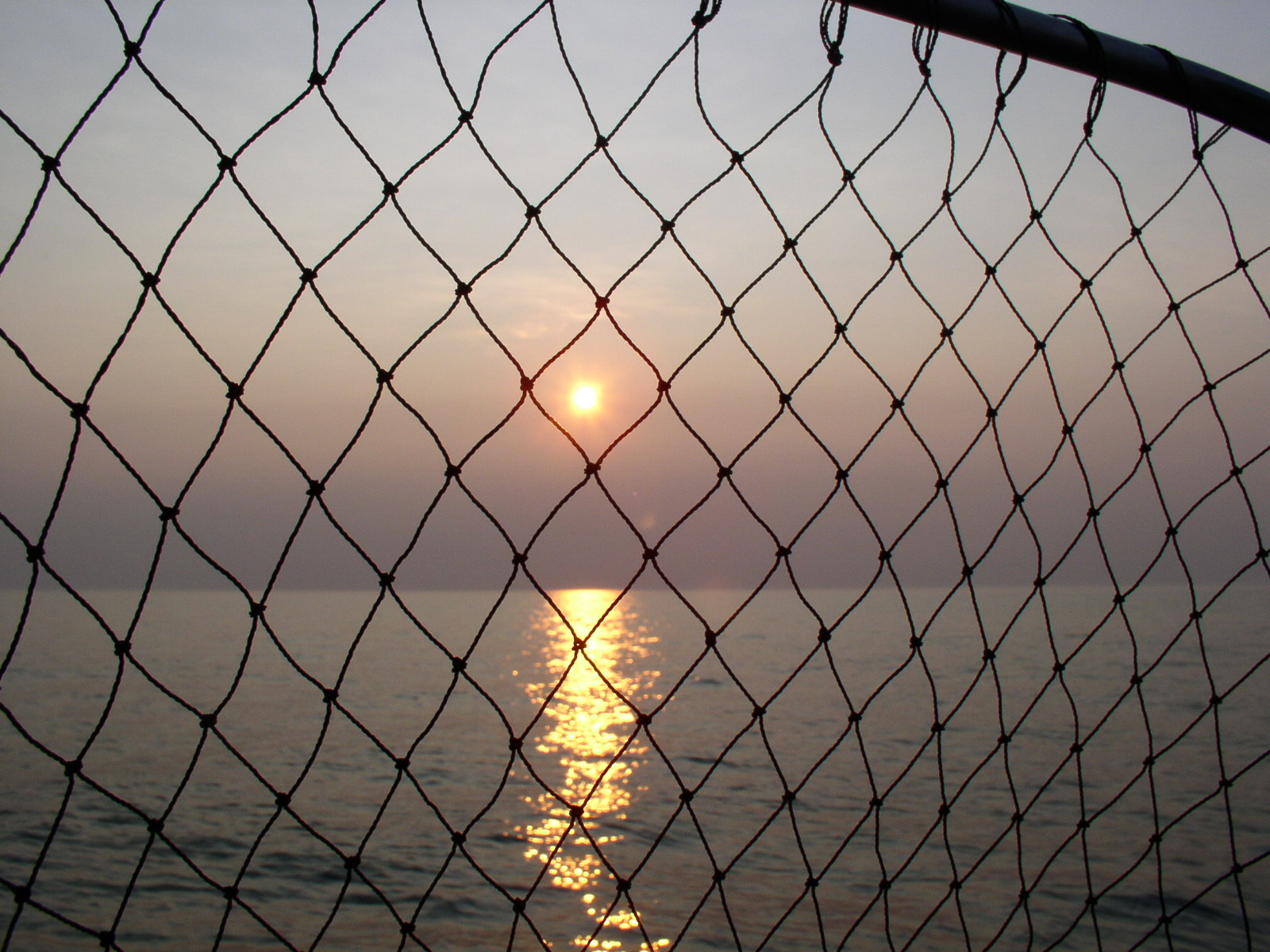
Actually, we can find this kind of construction in other, unexpected places. The loops of knitting are related, perhaps distantly, to the hitches and bends of sailors and the outdoorsy set. Speaking of sailing, early fishing nets were made by hand, using a series of connected partial loops, even though their present day descendents are more likely to be machine-made. Looks suspiciously familiar, no?

Catching some sun.

Catching some sun.

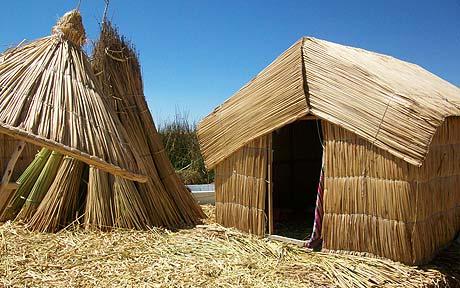
We can find other examples of knitting on a big scale besides giant needles and fishing nets. The islands of Uros in Lake Titicaca, Peru, are floating reed islands, which have been ‘knitted’ by their inhabitants. Apparently, the texture of these floating islands is so unique that people who live on them find walking on dry land very difficult. Not only have the reeds been built up to create spaces for people to live on, but their houses and buildings are also made of reed. A significant part of their environment is textile: it’s pretty nifty!

reed-houses-on-uro_1002576c

There are many outside of the Uros islands, however, who feel that they aren’t getting enough knitting in their lives. Enter guerrilla knitting, also known as knitting graffiti, kniffiti, or yarn-bombing. Avid knitters and other trouble makers add knitted goodness to their communities, and nothing is safe from their textile tyranny: trees, parking meters, bridges, lamp-posts, and even whole cars get the treatment. In some places, it’s meant to deter crime. In others, its a form of vandalism. Some might see it as the critical intervention of ‘craft’ in unusual locations. However you want to think about it, it’s fascinating, and often stunningly beautiful.

Tree-cozy.

Tree-cozy.

Speaking of gnarly knitters: there is a book that I treasured as a child, called The Secret of Platform 13, by Eva Ibottson, which I cannot recommend highly enough. There happens to be a very old lady in that book called Doreen, who works as a body guard for a rather nasty lady called Mrs. Trottle (but that’s neither here nor there.) What is so peculiar about Doreen is that her weapon of choice in her work as a body guard are her razor-sharp knitting needles, which she keeps on her person at all time. Now, this is not meant as an endorsement for using your knitting needles as weapons, Reader. I just think it’s sort of interesting that the author thought of using knitting needles, which are often seen as pretty feminine and harmless, as quite dangerous tools for this frankly unsettling character. Although, now that I think of it, the inimitable Miss Marple (heroine and detective extraordinaire from the brilliant mind of author Agatha Christie) also knits a great deal. Maybe we have been underestimating knitters all along.

So whether you want to make your world knitted, fill your city with yarn-bombs, or just knit big, this method of making a fabric has you covered. If, however, you are like me, and knit to un-knot your brows and your brain, then tally-ho, Reader! Either way, I hope this little romp has you inspired to get knitting and dream big. Or little. Whichever way you like it.

Until next time.

Yours,

Cotton Jenny
Crochet Coral Reef

Hello again, Reader.

In my first year of university, I had to take a maths credit course. Everyone warned me away from statistics, and I knew that calculus or algebra and I were not going to get along (thanks to our failed attempts at relationships all throughout grade school). I reluctantly signed up for the least offensive sounding course on offer: Math in Art.

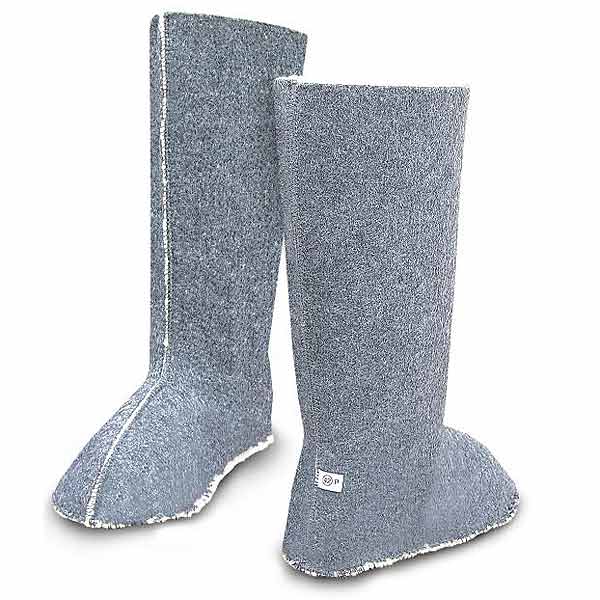
It was taught by a soft-spoken Russian professor, who made jokes about Donald Duck that no one understood, and a very peculiar teaching assistant. He was friendly, but he had a very intense personality, and he wore the felt liners of his winter boots in the class as though they were slippers. You could hear him swish-swish-swishing on the floor as he padded around at the front of the room, teaching us about rotations.

Swish swish swish!

Swish swish swish!

I digress.

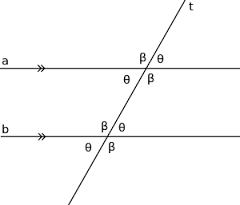
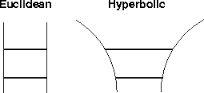
It was in this class that I first learned about hyperbolic geometry. Hyperbolic geometry is a kind of non-Euclidean geometry. Euclidean geometry asserts that, in two-dimensional space, for any given line a and point β not on a, there is exactly one line through a that does not intersect b; i.e., that is parallel to b. I don’t really know what that means either, but here’s a picture. Best of luck.

euclid

Hyperbolic geometry is non-Euclidean though, so this statement doesn’t apply. In a similar situation,hyperbolic geometry indicates that two distinct lines which pass through a don’t pass through bHere’s another picture.

hyperbolic

I wish I could comment more intelligently on the maths, reader, but I can’t. I’m sorry.

What I can talk about, however, is crochet.

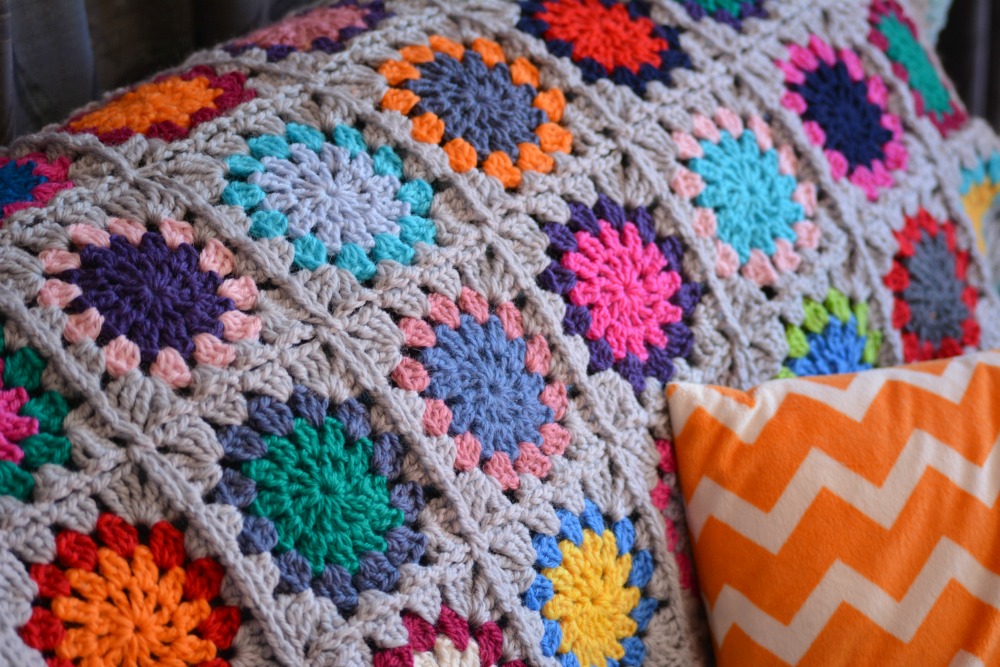
Crochet is a method of producing a fabric by linking together the loops of a single yarn or strand.There are all kinds of different crochet stitches, but they all function on this same basic principle. We usually think about crochet and imagine baby-blankets and afghans on our grannies’ couches.

So cozy! So stylish!

So cozy! So stylish!

Now you might be wondering how hyperbolic geometry and crochet are remotely related. Get excited, Reader: I am here to tell you.

Although hyperbolic geometry was developed and proved in the nineteenth century, it was nearly impossible to actually physically express it until very recently. Mathematicians thought about hyperbolic geometry as an abstract concept, not a physical reality. Even after the advent of computers, describing hyperbolic geometry still proved to be very difficult, which meant that for a long time, it was essentially a theoretical branch of mathematics.

A Latvian professor, Dr. Daina Taimina, first used crochet to express hyperbolic geometry in 1997. She saw her colleagues struggling to make flimsy and inaccurate paper models of hyperbolic planes, and decided to make more durable and accurate examples in wool. (What a smarty-pants.)

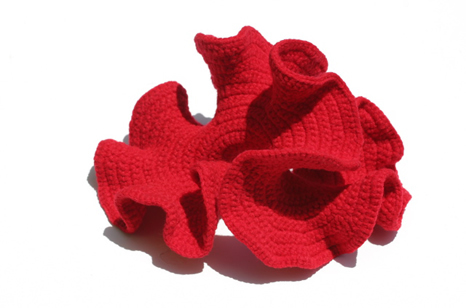
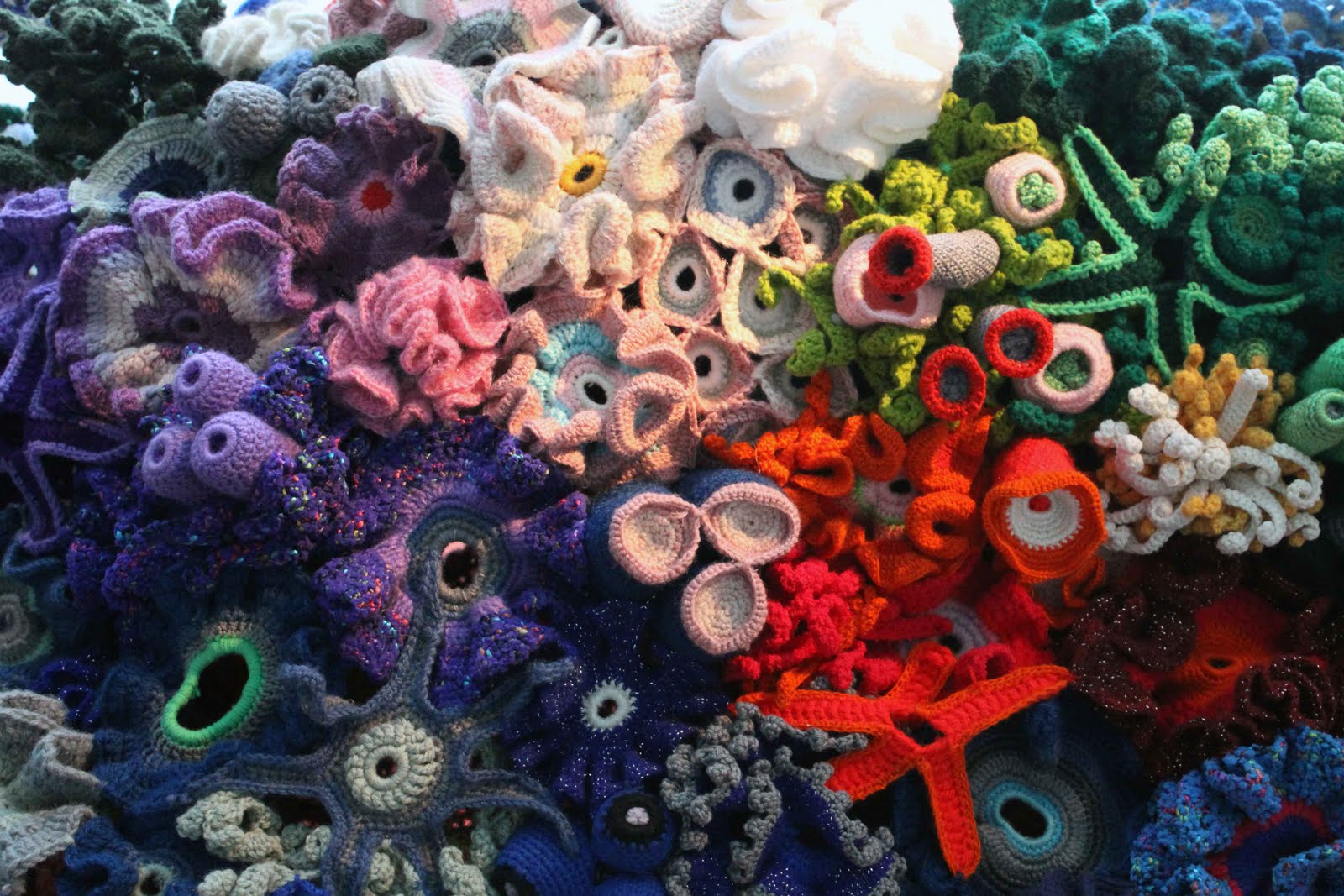
This idea was picked up by two Australian sisters, Christine and Margaret Wertheim. Margaret is a physicist, and Christine is an artist. As much as wool and water don’t normally mix well (think about the feeling of wet wool socks, and you’ll know what I mean) they realised that crocheting replicas of coral reefs actually made a lot of sense. The way that a coral grows and develops is in a hyperbolic plane. That frilled, crenulated doughnut shape is nature’s way of expressing hyperbolic geometry: good one, Mother Nature. And Dr.Taimina proved that crochet worked really well to express hyperbolic geometry too. So in 2005,  the Wertheim sisters developed an amazing project through the Institute for Figuring in Los Angeles: the Hyperbolic Crochet Coral Reef.

hyperbolic_space_clip_image001

At first, it was just them working on the project. But after a very successful show in 2007 in Chicago, more and more people became involved, and the exhibition project literally grew and grew. Now, approximately ninety-nine percent of the crochet coral is made by women, including the Wertheim sisters, and the exhibition has been shown all over the world.

This project deals with the intersection of mathematics, environmental issues, and crochet. When the project started in 2005, issues of global warming were at the forefront of a lot of scientific discourse. Not only does the Hyperbolic Crochet Coral Reef show its viewers mathematical information, it also explains some of the damaging results of rising sea temperatures, like bleached coral. Many of us don’t have access to a coral reef on a daily basis, but this exhibition gives us an idea of what this remarkable and environmentally crucial ecosystem is like, and how it is suffering as a result of climate change.

ErU0YAu

This project also does great stuff for women. Unfortunately, the fields of science and mathematics have been historically dominated by men, and that trend continues today. But things are changing. Projects like Crochet Coral Reef can show viewers both inside and outside the mathematics and science community that women absolutely have a place in these disciplines, and that their contributions, woolen or otherwise, are essential to advancement in the field. And that’s good news for everyone.

Want to learn more about this amazing undertaking? You can see Margaret Wertheim’s TED talk about her project here. The exhibition also has its own website, where you can check out photographs and see when the Crochet Coral Reef is coming to a museum or gallery near you!

So to all you crocheters out there, I say: keep up the good work! What you do is not only an art form, but also an excellent model for an important branch of (once) theoretical mathematics: how fancy! And to those of us who haven’t gotten hooked on hooking: you may never look at Grannie’s old afghan blanket the same way again.

Get hooked!

Get hooked!

Until next time, Reader.

Yours,

Cotton Jenny