Hello again Reader.
A few days ago, I was chatting with a friend about the Disney movie Hercules, and we remembered that the most awful scene of that whole film was when the three Fates (shudder) cut Meg’s life line. Little-girl me wasn’t a fan. But then, to be fair, there was nothing more vindicating than the following scene where there try to cut Hercules’ life thread, and their scissors won’t work, and the thread goes all gold, and the look on Hades’ face…

HERCULES, the three fates, 1997, (c)Buena Vista Pictures
I digress.
But it got me thinking about the thread. And about Disney. Disney is well-known for adapting fairy-tales and myths for the screen, so it wasn’t a huge jump to go from the thread and scissors in Hercules, to the spinning wheel in Sleeping Beauty, for example. I was intrigued. Out came some list paper and a pen, and I started to hunt for other myths and fairy-tales that deal with or use fabric and textile tools to tell a story.
I was surprised at how much there was to find. A collection of fairy stories from the British Isles by Kevin Crossley-Holland, called The Magic Lands (which I highly recommend) brought forth stories like “Tom Tit Tot”, which is the British version of the classic German fairy tale, or Märchen, “Rumpelstiltskin”. In it, an imp or devil (Rumpelstiltskin means “little rattle shaker”) agrees to help a hapless girl in need by using his magical powers to spin for her, but at a cost. In some versions, he spins flax into gold: a handy skill to have. In other variations, he simply spins an enormous quantity of flax: five skeins a day was the amount given in the version I grew up on.
Sleeping Beauty, as I mentioned before, is another example of a widely known fairy tale which uses a textile tool as an important plot device. It struck me as odd, and a little disconcerting, Reader, that the very tool many women have used throughout European history as part of their livelihood would become the weapon that caused the main female character harm. It’s sort of a “live by the sword, die by the sword” situation, except that we recognise swords as purpose-made weapons. Spinning wheels are, I hope, not generally built to magically paralyse young women.
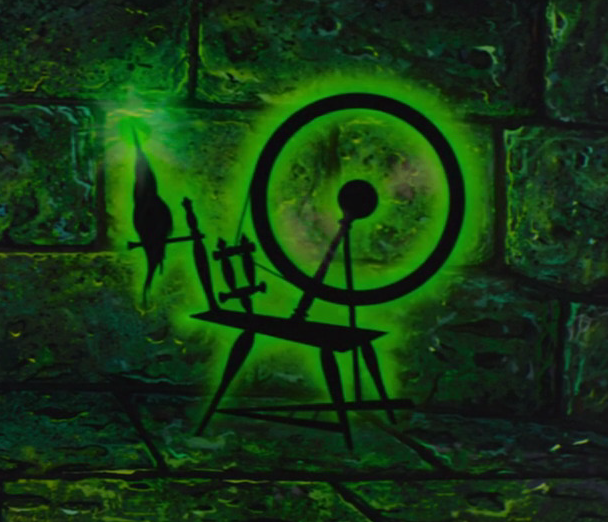
Yes, I’m looking for a spinning wheel with a ghostly green glow that will send me into a deep, nearly permanent, death-like sleep. Do you carry anything like that?
Speaking of women’s tools: as soon as you start searching for textiles in fairy tales, women crop up. And I mean everywhere. Weirdly, though, the same few types of women keep appearing. There’s the young, often pretty, girl who doesn’t know what she’s doing and gets herself into trouble, but rarely suffers terribly as a result of her ignorance (Little Red Riding Hood). There are really, really really old ladies: most are witches, and most witches are villains. There are some old, magical women, however, who are either neutral parties who watch the action but don’t take sides,, or sometimes are kindly and helpful, like the fairies in Sleeping Beauty. Many stories feature mothers who either help their children (biological mothers) or are perfectly horrible(step-mothers); the kindly and shrewd mother in “Mossy-Coat”, which is a variation of Cinderella, makes her daughter a magical coat of moss, hence the name, and sends her out into the world to find her fortune, which she eventually does.
Have you also noticed, Reader, that many of the women we meet in myths and fairy stories get their names from the clothes they wear, or from their appearance? Little Red Riding Hood, Mossy-Coat, Cinderella, Snow White, Belle, and Sleeping Beauty are all named for what they look like and what they put on their bodies. Does that mean that Little Red Riding Hood, or Röttkappchen as she is known in the German original, doesn’t have a name if she’s not wearing her signature garment? By the way, despite popular depictions of this character, riding hoods are not capes. They are detached hoods, usually with a fastener for under the wearer’s chin. Riding hoods are a bit more like hats or bonnets than capes or cloaks. So while we often think of a little girl in a flowing red cape, what the original story-tellers might have actually imagined is quite different.
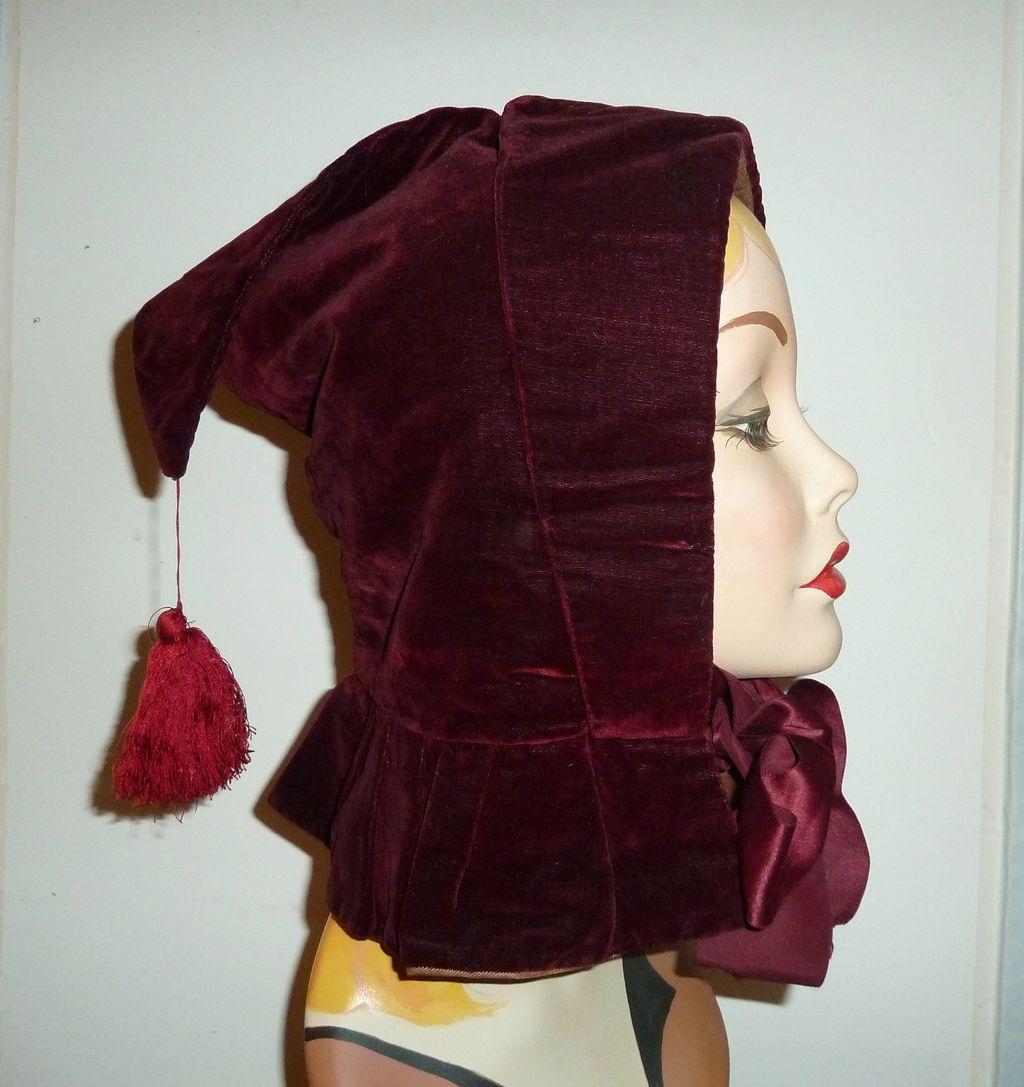
This is an example of a Victorian hood: certainly it is much later than the original story of Rottkappchen, but the Victorians were deeply interested in German fairy tales, thanks in part to their moralising qualities, and to the fact that their beloved Queen Victoria and Prince Consort Albert were German.
That’s not to say that men don’t come up in textile-based fairy stories. They do. Their roles are slightly different, though. They tend to work with textiles and fabrics professionally: tailors appear as main characters in many lesser-known fairy tales. A story taken again from Crossley-Holland based on an old tale called “The Wee Tailor” introduces us to the courageous tailor Billy, who takes his friends’ dare and assures them that “he’s not frit” to go and sew in the village graveyard at midnight. Of course, once settled upon a tombstone in the graveyard, Billy’s work is disturbed by malevolent phantoms and corpses, but he uses his wit and his sewing to escape unscathed.
Here we see, I think, an instance in which fairy tales can act as mirrors, showing us who we are even as we tell them. They tell us what we are afraid of: death, violence, pain, loss, and the unknown. They remind us of what we think is funny and important, and what evil looks like and how it acts. They show us how we value men and women differently. And I think, Reader, that they also indicate that our imaginations find the ties between textile metaphors and life too good to pass up. We like to think of life as a thread, measured out and then cut when the time is right. Thinking about the ways in which our life’s thread weaves with the threads of those around us into a tapestry is pleasing to us. And telling the stories that make up our lives, does seem remarkably like spinning a long, twisting, and sometime tangled, yarn.
On that note, Reader, here’s to long and bright life threads.
Yours,
Cotton Jenny
 cottonjennyfabrics
Intriguing thought about buying a “glow in the dark” spinning wheel. Where would one even begin?
LikeLike
I can only assume some kind of evil-genius warehouse and emporium. Good question!
LikeLike